Wednesday, August 17, 2022

Recession risk increasing as Fed maintains tighter monetary policy

(17 August 2022) As the rising cost of living forces consumers to cut back on spending, it seems the risk of recession is increasing.  The economic outlook remains very uncertain despite encouraging signs that inflation may be moderating while employment continues to grow, albeit largely from part-time jobs.  Nonetheless, recent data is very much a mixed bag.  This week's housing report came in below expectations and July's ISM manufacturing data extended its downward slide, even if it not quite showing a contraction.   Perhaps more worrying is that China's stubborn adherence to a zero Covid policy is wreaking havoc on the world's second largest economy as this week's data was weaker than expected. 

As we know, Saturn is the planet that is most closely associated with recession.  As the planet that symbolizes caution, pessimism and loss, Saturn is usually prominent by aspect and sign placement during times when the economy is slowing.  During the initial Covid outbreak and subsequent lockdowns in early 2020, Saturn was doubly prominent since it entered the sign of sidereal Capricorn and conjoined Pluto.  At the time of the financial meltdown in 2008, Saturn formed a very rare, simultaneous alignment with Uranus, Chiron and Neptune.

Therefore, if there is going to be a recession, we should also see some similar Saturn influences in the transit chart.   In previous posts, I have documented how this year's slowdown was correlated with the Saturn-Neptune-Rahu-Jupiter alignment that was within range between April and July.  While that alignment has now separated and exerts a diminishing influence, we can see that Saturn is due to form an alignment with Uranus in October.  The Saturn-Uranus square will be closest at the time of the Saturn direct station on October 23.  While this single aspect may not not sufficient to signal a recession, it nonetheless increases the likelihood of further slowing, if not an outright recession by that date. 
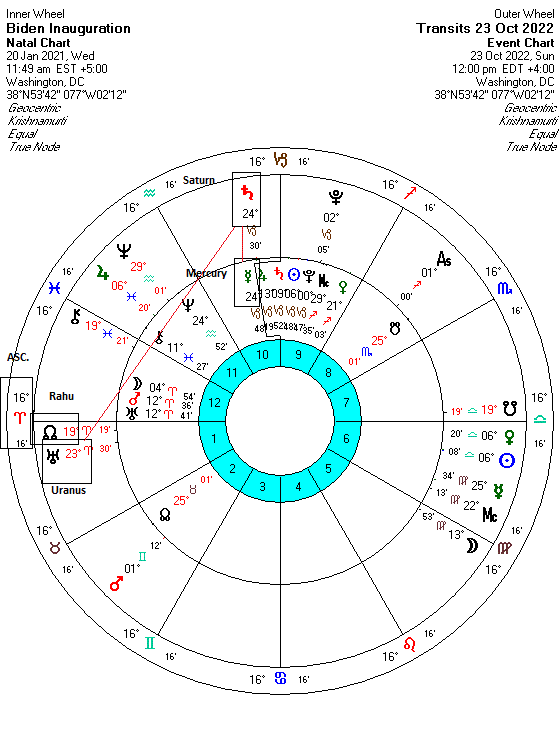


Another intriguing perspective on the US economy can be found in the inauguration horoscope of the current president.  The inauguration chart represents the "re-birth" of the country every four years and thus generates a map of its changing planetary fortunes, both for the president and the nation as a whole.   What stands out here is that the this fall's Saturn-Uranus square will almost exactly align with the natal Mercury (24 Capricorn) in the inauguration chart.  This is very difficult alignment that greatly increases the likelihood of problems and setbacks for the US during October. 

While the Saturn-Uranus square is in itself a negative influence for the economy and the stock market, its impact on natal Mercury could further undermine economic activity since Mercury symbolizes commerce, transportation and communication.  Since all three areas are directly connected with the economy, any specific damage to one of them would have a detrimental effect on GDP. 

Mercury's symbolism is not limited to the economy, however, as this affliction could also coincide with tension and conflict associated with the midterm elections slated for early November.  At its most general level, Mercury represents rational thought processes such as counting and calculation, so its affliction by Saturn and Uranus could translate into unusually divisive troubles related to the often contested terrain of US politics.
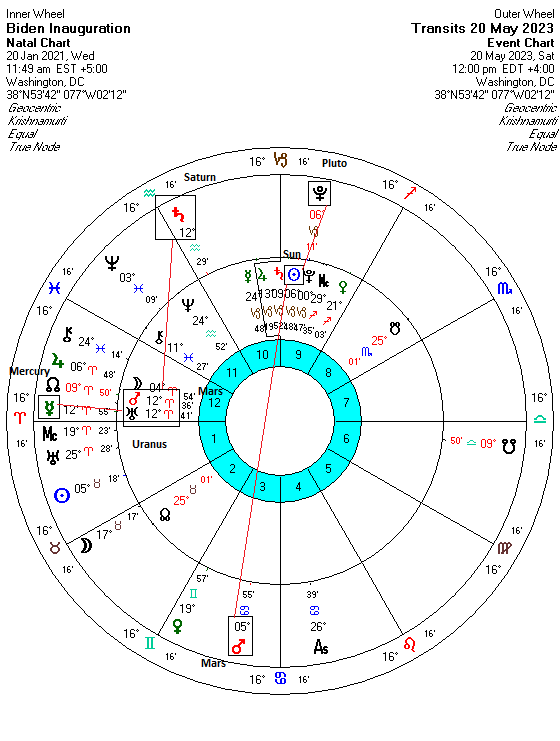


Besides this Saturn-Uranus aspect, Saturn will also form some difficult aspects in the inauguration chart in the spring of 2023.  First, Saturn (5 Aquarius) will align with Pluto (5 Capricorn) in the winter of 2023, although this alignment may only have a limited recessionary impact since it will be relatively short-lived. 

The more worrisome aspect occurs from May to July when Saturn stations retrograde in the 11th house of income at 13 Aquarius and thereby casts its full-strength 3rd house/60 degree aspect on the dangerous Mars-Uranus conjunction in the 1st house at 12 Aries.   While Mars does have any direct connection with the economy, it is associated with military action.  The Saturn influence here upon Mars-Uranus suggests increased risk of major economic losses from military conflict.  And with Pluto also conjoining the natal Sun at that time, there is an additional layer of affliction here that could bring an unstable geopolitical situation that further undermines economic confidence. 

All in all, these different Saturn influences over the next year or so greatly increase the risk of a recession in the US.  Even if the Fed ultimately succeeds in taming inflation, unemployment is likely to rise significantly by next year while the stock market should trend lower. 

For more details, check out my weekly subscriber newsletter which is published every Saturday afternoon (EST).   In addition to reviewing the key planetary and technical influences on US and Indian stocks for the short and medium term, I also provide an astrological analysis of potential upcoming moves in currencies, gold and oil.

Wednesday, August 10, 2022

Trump's Mar-a-Lago raided by FBI

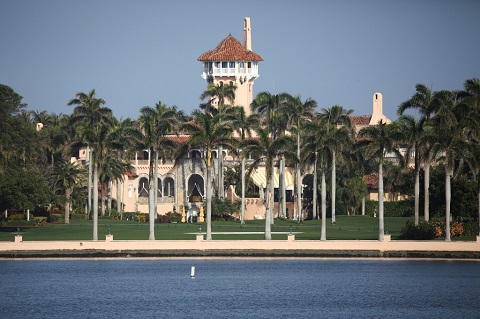
(10 August 2022) The US political landscape has been turned upside down following the FBI's raid on former President Trump's residence at Mar-a-Lago.  The unprecedented raid on the private home of a former president has created a firestorm of reaction comprised of equal parts indignant outrage and gleeful cheerleading as pundits scramble to determine its ultimate political impact. 

It's still early but it seems to have galvanized the GOP behind Trump even more than before.  Even though Florida Governor Ron DeSantis remains his leading rival to be the nominee in 2024, Republicans appear to be circling the wagons around Trump.  Of course, all this is subject to change depending on what the DOJ chooses to share regarding the legal justification for the search and what evidence was actually found. 

Not surprisingly, Trump's horoscope is suffering from several major afflictions these days.  Trump felt the impact of Monday's Mars-Saturn square as it came to within just 3 degrees of his Midheaven (MC), or unequal 10th house cusp.  The 10th house represents status and career so this double dose of malefic energy was very likely to coincide with some kind of setback.  While the 10.54 a.m. birth time is from birth records and considered accurate, it is not unreasonable to think that it could be a few minutes earlier which would make the Saturn-Mars alignment that much closer. 

The other transit that stands out is the Venus-Pluto opposition that activates his 12th house Venus.  The 12th house represents loss, isolation and confinement so this affliction highlighted this unfortunate natal placement.  The 12th house Venus conjunct Saturn is one of the classic astrological signatures for divorce and Trump is twice-divorced.  Venus is usually a benefic planet but it's placement in the 12th with Saturn makes it more vulnerable to unwanted outcomes when it is transited by negative planets. 


Venus not only pertains to marriage, but also to career since it rules the sign of Taurus which is in his 10th house.  The key point to note here is that the Venus-Venus conjunction isn't the problem; rather it is the Pluto opposition that is activated by the faster-moving Venus.  With Pluto symbolizing power and coercion, especially of a Machiavellian nature, we see Trump here on the receiving end of the Democrats' political wishes, as executed by the the DOJ and the FBI.  

The other difficult influence here is that transiting Saturn (28 Capricorn) is now under the 5th house/120 degree aspect of natal Rahu (27 Taurus). Since Rahu is tightly conjunct the Sun in Trump's natal chart, this Saturn transit is more likely to undermine Trump's authority, sense of leadership and personal vitality.   And we shouldn't forget that Trump's Sun continues to be afflicted by the square aspect with Neptune as it has for the past year or so.  This Neptune influence has further damaged his fortunes since it has a dissolving influence upon the Sun. 

Looking ahead, I think Trump will remain in the defensive for a while yet.  As I've written previously, his chart is significantly weakened by the dual afflictions of two aspects involving slow-moving outer planets: Neptune-90-Sun and Pluto-180-Venus.  Both will remain within range for the rest of 2022 and even into early 2023.  After it completes its current retrograde cycle in October, Saturn will again come under the negative influence of natal Rahu in December 2022 and January 2023.  This will be a particularly difficult time for him when the threat to his reputation and career could be at its greatest. 

Democrats are hoping to indict him on criminal charges in order to make him ineligible to run in the 2024 election.  While his chart is certainly bad enough that I wouldn't rule anything out for these next six months,  I still think Trump is likely to run in 2024 and stands a very good chance of winning.


Weekly Market Forecast

Stocks rallied today as the latest CPI report showed prices rose at a slightly slower pace of 8.5% in July suggesting that inflation may have peaked.  The rally follows some early week weakness that coincided closely with the tense Mars-Saturn square.  As it often the case, stocks tend to do better once an alignment involving malefic planets (e.g. Mars, Saturn)  begins to separate. 

I would not be surprised to see some kind of pullback over the next few days given Thursday night's Full Moon.  Full Moons have a slight bearish bias in any event, but this one is more likely to signal caution since it will form a conjunction with Saturn within just a few degrees.  The Sun-Saturn opposition is due to be exact on Sunday-Monday, so there is some additional downside risk heading into next week.

For more details, check out my weekly subscriber newsletter which is published every Saturday afternoon (EST).   In addition to reviewing the key planetary and technical influences on US and Indian stocks for the short and medium term, I also provide an astrological analysis of potential upcoming moves in currencies, gold and oil.

Wednesday, August 3, 2022

Stocks choppy ahead of Friday's US jobs report

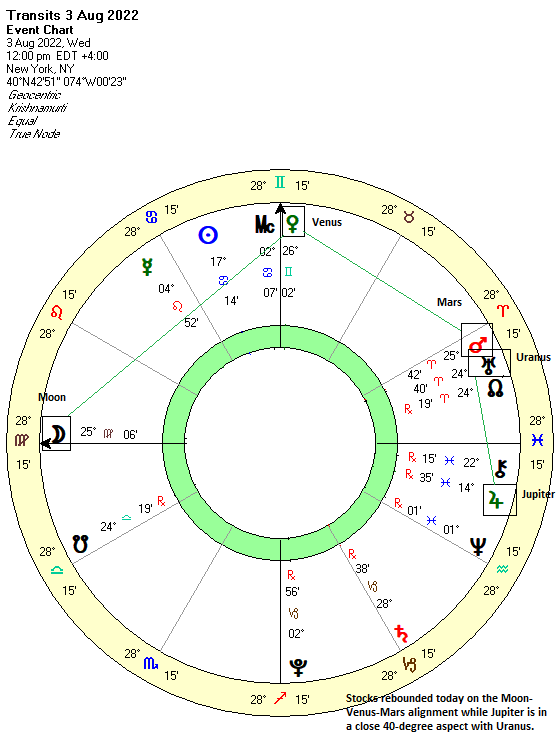
(3 August 2022) Stocks have been choppy to start the month of August as strong corporate earnings have mostly offset recession fears amid weakening macro data.   As expected, stocks fell in the early week as Mars conjoined Uranus and Rahu (North Lunar Node) -- and thereby activated the underlying Saturn-Neptune-Uranus-Chiron alignment -- although the decline was fairly modest despite geopolitical jitters from Speaker Pelosi's trip to Taiwan.  Wednesday's rebound was also not too surprising as the Moon aligned with Venus and Mars.  While US stocks are still very much in rebound mode following the June low, it remains to be seen if this year's down trend is truly over. 

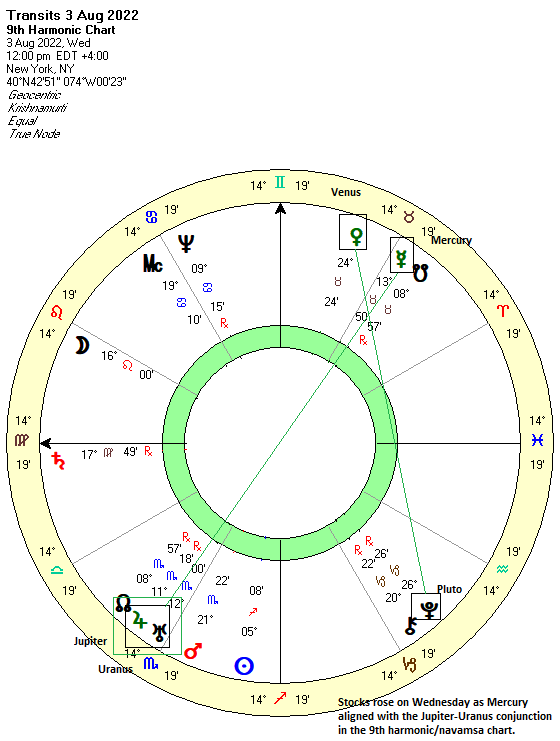
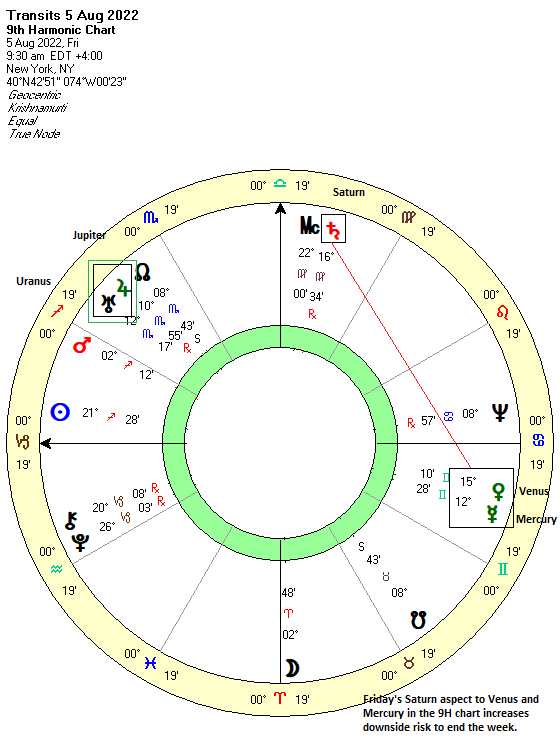
One explanation for the relative strength in the market in recent weeks can be understood in terms of the navamsa, or 9th harmonic chart.  This chart is commonly used in Vedic astrology to provide an additional perspective on the relative planetary strengths above and beyond what a normal transit analysis would provide. 

It should be noted that Western astrology also uses the 9th harmonic, although it does not grant it the analytical primacy that Vedic astrology does.  The basic premise of the navamsa chart is that planets have a special resonance when their natal rasi positions are multiplied by 9.  In this way, the navamsa chart highlights the importance of the 40-degree novile aspect which is a key divisor of the 360 degree circle. 

The recent Jupiter retrograde station on July 28 is a good example of the mechanism behind the 9th harmonic navamsa chart.  Jupiter retrograde stations tend to be bullish in any event since the velocity of Jupiter is slowing both before and after the station.  One of the fundamental axioms of financial astrology is that slow moving planets have a greater capacity for good or ill depending on their nature.  As Jupiter slows around its stations, markets are more likely to rise. 


But with this particular station, we can see that Jupiter (14 Pisces) formed a near-exact 40-degree novile aspect with Uranus (24 Aries).  Since Jupiter-Uranus aspects are invariably bullish, this influence increased both the probability and the strength of the positive market outcomes towards the end of July.  Expressed in terms of the navamsa/9th harmonic chart, however, Jupiter and Uranus were conjunct. 

As we can see in today's navamsa chart, this 9th harmonic Jupiter-Uranus conjunction is still within just one degree at 11-12 Scorpio.  Today's bullish outcome was made more likely because this Jupiter-Uranus alignment was opposite Mercury, another bullish influence.  And with Venus in a favourable 120-degree alignment with Pluto and moving past the potentially bearish influence of the Mars aspect, there were a clear majority of bullish influences in this chart.


Looking ahead to Friday's US jobs report, we can see the 9th harmonic/navamsa chart looks more afflicted.  The Jupiter-Uranus conjunction will still be close at hand although now two degrees away, but the real problem is that Saturn will square both Mercury and Venus within a few degrees each.  This increases the downside risk for the end of the week and suggests a negative reaction to the jobs report. 


In this way, the navamsa/9th harmonic can provide useful additional information to the main rasi transit chart which can help tip the interpretive balance one way or the other. 

For more details, check out my weekly subscriber newsletter which is published every Saturday afternoon (EST).   In addition to reviewing the key planetary and technical influences on US and Indian stocks for the short and medium term, I also provide an astrological analysis of potential upcoming moves in currencies, gold and oil.


Wednesday, July 27, 2022

Fed hikes rates 75 basis points amid recession talk; stocks rally

(27 July 2022) What is a recession?  Up to now, economists have defined it as two straight quarters of negative growth.  But if the Biden White House has its way, that could be changing.  Tomorrow's GDP report is expected to deliver a negative Q2 print which would fulfill the definition of a recession since Q1 was also negative.  But this week White House officials such as Treasury Secretary Janet Yellen and even Fed Chair Jerome Powell have suggested that the US is not in a recession and the definition should be more flexible to account for a relatively healthy job market. To be sure, unemployment remains under 4% although numbers are beginning to creep higher.

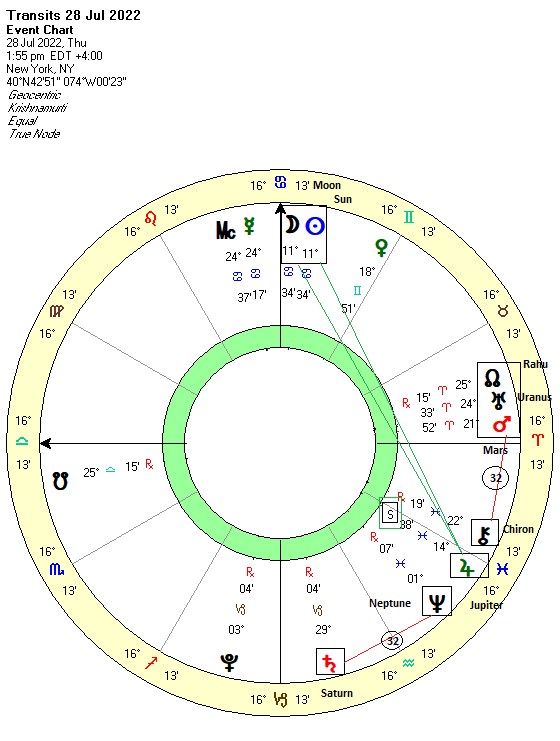
Stocks surged higher today as the Fed hinted it could pause rate hikes if inflation shows signs of moderating.  The rally was not hugely unexpected given tomorrow's Jupiter retrograde station.  Jupiter, the most bullish planet, stations twice a year wherein its direction appears to reverse from our perspective on the Earth.  The five-day periods around these stations can often coincide with positive market outcomes since Jupiter's unusually low velocity increases its positive influence.  As expected, we saw some early week selling on the Mercury-Mars square but once that alignment had moved past exact late on Tuesday, sentiment became more positive as Jupiter's energy could shine through unimpeded. 

I would note that tomorrow's New Moon aligns fairly closely with that stationary retrograde Jupiter and therefore could well coincide with more optimism.   The Moon exactly conjoins the Sun around 2 pm EDT in New York, while Jupiter will turn retrograde around 4.30 pm, shortly after the close of trading tomorrow.    But just to muddy the waters, there is a bearish contraparallel due tomorrow also, as Mars (15N00) aligns with Saturn (-15S00) and introduces the possibility of a reversal lower, later in the day or perhaps on Friday.


However, my attention is more focused on the triple conjunction of Mars, Uranus and Rahu (North Lunar Node) set for Monday, August 1.  On paper, this is a nasty-looking set up involving two malefics (Mars and Rahu) that suggests high-energy and unpredictable events which could bring some significant troubles.  While this alignment looks bad, a quick check of the historical record shows that previous similar triple conjunctions in January 1992 and April 2007 did not coincide with any major market moves.  And the late April 2007 alignment was actually bullish for the market.  Therefore, we should be careful not to jump to any conclusions. 

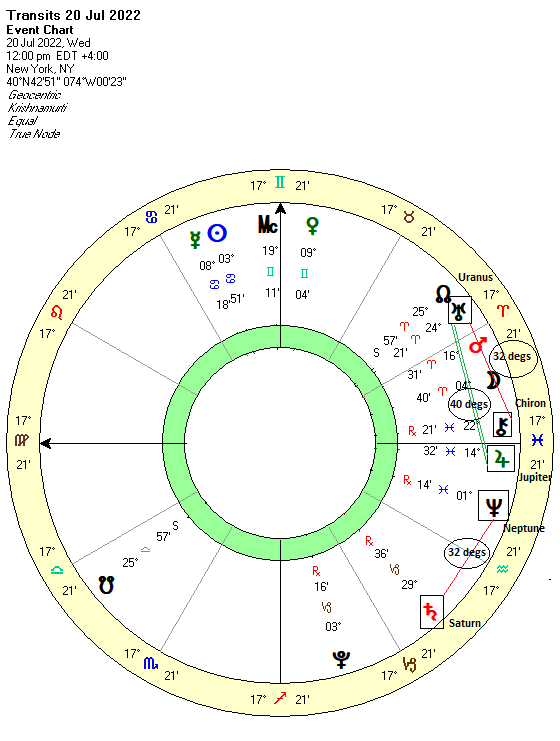
And yet there is still some downside risk associated with this triple conjunction since the transit of Mars in particular could activate the ongoing Saturn-Neptune-Uranus-Chiron alignment.  As I have previously noted, this four-planet alignment is one reason why markets have been declining in recent months.  The difficulty stems from the fact that the Saturn-Uranus midpoint (12 Pisces) is conjunct the Neptune-Chiron midpoint (12 Pisces). This conjunction of midpoints sets up a bearish resonance since Saturn is the decisive negative influence amid the other three neutral planets.

Another way of understanding this alignment is that the angular separation of Saturn (29 Capricorn) and Neptune (1 Pisces) is 32 degrees, which is the same distance between Uranus (24 Aries) and Chiron (22 Pisces).  Since all four of these planets move very slowly, they usually require faster-moving trigger planets to activate the other four planets either by conjunction or by other alignments with 32 degrees of separation.  This is what happened last Friday July 22, as the market fell by more than 1% when Mercury and Venus were separated by the same 31-32 degrees.   With Mars due to conjoin Uranus (and Rahu) next week and thereby setting up a potential 32 degree trigger of the larger Saturn alignment, there is good reason to be cautious.  Let's see what happens.

For more details, check out my weekly subscriber newsletter which is published every Saturday afternoon (EST).   In addition to reviewing the key planetary and technical influences on US and Indian stocks for the short and medium term, I also provide an astrological analysis of potential upcoming moves in currencies, gold and oil.


Wednesday, July 20, 2022

Markets push higher ahead of ECB and Fed meetings

 (20 July 2022) Financial markets are still in rebound mode this week as investors await the outcome of tomorrow's ECB decision and next week's FOMC meeting on July 27.  Since the low of 3636 on the S&P 500 on June 17, stocks have been attempting to recoup some of their losses as investors consider the possibility that inflation has peaked.  Certainly, falling commodity prices are one reason to think that inflation may be cooling off, and if that is the case, then the ECB may only hike a minimum 25 basis points and the Fed may be satisfied with just another 75 point hike. 

Regardless of the rate decisions, it remains to be seen if this is the end of the correction or just a bear market rally that will ultimately fail and lead to lower lows.  On the whole, the planetary influences do not look overly positive for the coming months and suggest that lower lows are very possible.   But could this current rebound last a while longer?

We can look for clues in the horoscope of the NYSE (May 17, 1792).  As I have noted previously, the decline since April has been closely correlated with the 30-degree alignment of Saturn and Neptune.  The influence of this alignment was exceptionally strong since 1) Saturn stationed retrograde in early June and 2) it also formed a larger midpoint-based alignment with Uranus and Chiron.  Since the angular separation of Saturn and Neptune as well as Uranus and Chiron is approximately 30 degrees, their negative impact has lasted for an unusually long time.  As a rule, any alignment involving Saturn is a negative influence on sentiment and its effects can be magnified if slower moving planets are involved as is the case here. 


We can see an additional source of a pessimism since Saturn (29 Capricorn) forms a close 60 degree aspect with the natal Moon (28 Pisces).  This Saturn-Moon aspect will be exact on August 8 although it is already within effective range and may only require a faster-moving planet to act as catalyst.

And yet even though the bearish Saturn alignment remains within range both by transit and natally, we still are in the midst of a sizable rebound.  Why?  One reason is that bullish Jupiter has become stronger in July ahead of its retrograde station on July 28.  Markets tend to do well when Jupiter is strong, either when it is aspecting other planets and/or if its velocity is low.  Planetary velocity is much lower during the period around the direct and retrograde stations and thus we should not be surprised to see some upside here as Jupiter slows down before turning retrograde. 

The other factor I would note here is that Jupiter (14 Pisces) forms a kind of hidden alignment with Uranus (24 Aries).  While Jupiter does not form a conventional Vedic aspect with Uranus, it is conjunct in the navamsa, 9th divisional chart.  This is the same thing as forming a 40 degree aspect in the rasi natal chart (360/9 = 40).   The 40-degree aspect is also a divisor of the circle and thus should be taken seriously as a possible angle of resonance between planets.  It is also broadly bullish that Jupiter forms similar navamsa-type alignments with Uranus (24 Cancer) and Chiron (24 Gemini) in the NYSE chart.


It is therefore possible that markets can avoid another decline at least until the Jupiter retrograde station on July 28 -- just one day after the FOMC meeting.  In this scenario, the positive Jupiter influence could largely offset the underlying negative influence of the Saturn-Neptune-Uranus-Chiron alignment. Once Jupiter begins to move backwards, however, it could shift the balance of planetary energies and give bears the edge once again.

More immediately, I do wonder about the rest of this week.  Tomorrow's Moon-Mars conjunction doesn't seem very positive although the Mercury-Venus alignment seems more bullish.  By itself,  the Mercury-Venus alignment could coincide with some upside since both planets are benefic by nature, and that could well be the case later this week. 

However, I would note that Mercury and Venus will be separated by 30 degrees on Thursday and 31 degrees on Friday.  This is close enough that it could set up a negative resonance with the Saturn-Neptune alignment (= 32 degrees) which could bring further weakness.   Market direction is therefore somewhat uncertain, although the closeness of the alignments suggests a large move is more likely.  Some increased volatility is more likely early next week ahead of the Fed meeting as Mercury squares Mars.


For more details, check out my weekly subscriber newsletter which is published every Saturday afternoon (EST).   In addition to reviewing the key planetary and technical influences on US and Indian stocks for the short and medium term, I also provide an astrological analysis of potential upcoming moves in currencies, gold and oil.


Tuesday, July 12, 2022

Euro falls to parity with US dollar as energy crunch cuts growth

(12 July 2022) It was an historic day on currency markets today as the Euro fell to parity with the US dollar for the first time since 2002.   After briefly trading at 0.998 to the dollar today, the Euro has fallen more than 20% since its pandemic high in January 2021.  The European economy has been struggling with the double whammy of post-pandemic inflation and severe energy shortages that have resulted from the Russia sanctions following the war in Ukraine.

The reference to 2002 is no coincidence, of course, since that was also a time of financial disruption and recession following the the bursting of the tech bubble.  US stock markets have lost about 20%  of their value this year following the pandemic bubble as the Fed attempts to bring inflation under control by raising short term interest rates.  However, the ECB's efforts to fight inflation have been hamstrung by the crippling effects of the energy shortage as higher rates are a non-starter in an economy quickly sliding towards recession.  As a result, the currency is taking a beating as the ECB lags further and further behind the Fed as capital flees in search of higher yields, most notably the US. 

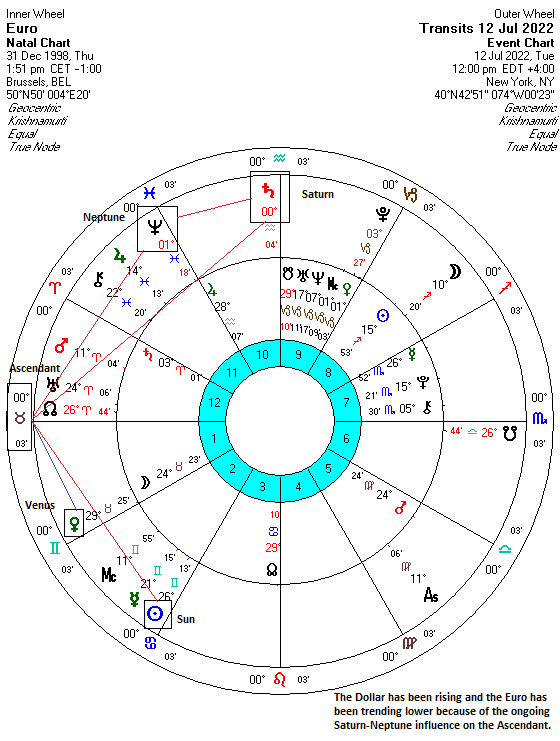
The Euro woes are clearly seen in its horoscope.  Signed into existence on December 31, 1998, the Euro is getting hit hard by this ongoing Saturn-Neptune alignment.  Saturn (0 Aquarius) is the major culprit here, but its 30-degree alignment with Neptune (1 Pisces) only serves to magnify its effects.  And there is further magnification of the Saturn influence since it just stationed retrograde in early June within a one-degree alignment with the Euro Ascendant at 0 degrees of sidereal Taurus.  It is hard to imagine a more difficult protracted influence in a chart.  Due to their slow velocities, Saturn and Neptune have been sitting very close to 0 degrees of their respective signs since April.  This not only accounts for the decline in the Euro but also most risk assets such as stocks and an increasing number of commodities.


But with Saturn re-entering Capricorn on Thursday, there could be some temporary relief coming to the Euro.  This week may also be pivotal since Venus and the Sun align with the Ascendant and could act as additional triggers for the bearish Saturn-Neptune energy.  Wednesday's Venus-Saturn-Neptune alignment could see a significant move and Friday's Sun-Saturn alignment also looks potent. But as Saturn moves further into Capricorn, it should reduce its influence on the Ascendant in the Euro horoscope.  

As it happens, all eyes will be on tomorrow's US CPI report.  If the CPI comes above last month's 8.6%, then we could see the dollar rally further at the expense of the Euro.  That is certainly possible, since Venus makes its exact alignment with the Euro Ascendant tomorrow.  However, I am uncertain about how the market will react since Venus is often a bullish influence when it aspects major chart points such as the Ascendant, the Moon or the Sun.  Certainly, there is some downside risk if only because Venus may act more as a conduit for the negative Saturn influence.  Friday's Sun-Saturn-Neptune alignment looks somewhat more negative, however, both for the Euro and for stocks. 


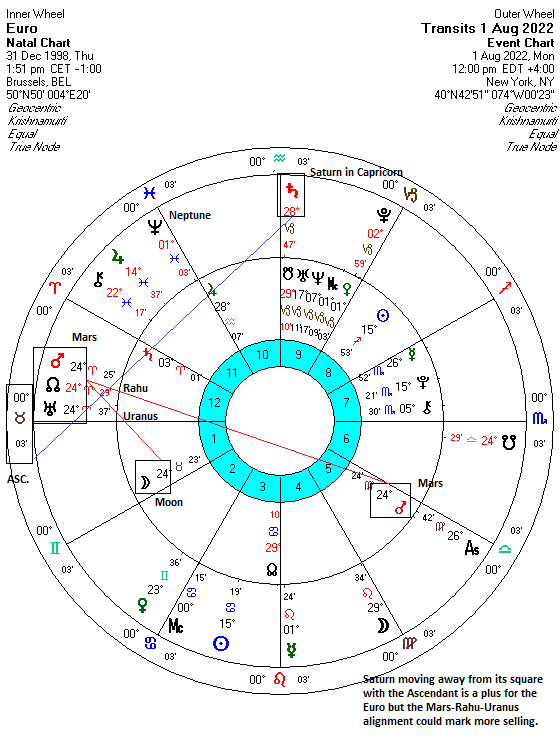
Even if the Euro rebounds from here in the coming days, it is hard to be too optimistic going forward.  The nasty triple conjunction on August 1 of Mars, Uranus and Rahu aligns with the Moon (24 Taurus) and Mars (24 Virgo) in the Euro and is very likely to see more selling.  And if that isn't enough, Saturn will station direct at 24 Capricorn in October thus setting up another exact alignment with the natal Moon-Mars.  The bottom line here is that the Euro seems likely to fall further in the weeks and months ahead. 


For more details, check out my weekly subscriber newsletter which is published every Saturday afternoon (EST).   In addition to reviewing the key planetary and technical influences on US and Indian stocks for the short and medium term, I also provide an astrological analysis of potential upcoming moves in currencies, gold and oil.

Photo Credit: shankar s.

Tuesday, July 5, 2022

Bond yields fall on recession fears

 (5 July 2022) It seems we've entered in a good news, bad news economic situation for the moment.  The good news is that bond yields have finally started to fall amid early signs that inflation may have peaked.  The bad news is that yields are also falling in anticipation of a possible recession as the latest data is coming in below expectations.  While the US job market remains robust, manufacturing output is down and consumer spending has also take a hit in response to sharply rising prices. 

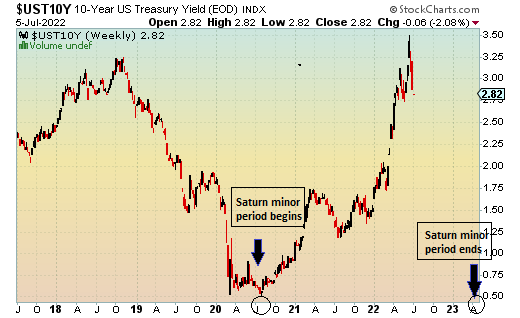
In this respect, the bond market is a useful indicator on the overall state of the economy.   Surging inflation forced yields higher in the first half of 2022 and forced the Fed to quickly abandon its dovish policy and tighten its monetary policy.  But after peaking on June 14 at 3.49%, the 10-year Treasury yield has since moved below 3%, closing today's session at 2.82%. 

If yields continue their retreat, the odds of a recession will rise as investors begin to factor in slower growth and diminishing inflation risk.  The silver lining in that case would be that the pressure would come off the Fed to hike rates.  Even if another 75 point hike on July 27 is already baked into the market, significantly lower bond yields could help the Fed take a "pause" at its September meeting. 

Using financial astrology, we can make some speculative inferences about the future direction of interest rates and bond yields.  The horoscope of the first trade of US Treasuries (Aug 22, 1977) is especially helpful in this respect.  In terms of interpretation, the basic rule of thumb is that an afflicted chart would suggest lower prices for bonds and thus higher yields, since they have an inverse correlation.  A more favourable chart pattern would indicate increased demand for Treasuries and hence, lower yields. 


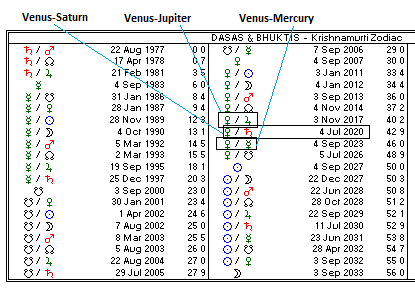
Currently, the chart is running the Venus-Saturn dasha period.  Venus is a benefic planet, of course, and its placement in the 11th house of gains is even more positive. This suggests that the Venus major dasha period (2007-2027) should be generally favourable for bond prices.  Indeed, bonds have generally done well since the 2008 meltdown aa yields have been kept artificially low by the Fed's QE policy.   At the start of the Venus period in Sep 2007, the 10-year Treasury yielded 4.5%.  Interest rates have been in a downtrend in the 15 years since, with the 2020 Covid low at just 0.5%. 


But the other part of the dasha equation is Saturn.  The Saturn minor dasha period (July 2020 - Sep 2023) looks less positive for bonds.  Saturn is a natural malefic and it is very badly placed in the 12th house, and just one degree away from the equal house cusp.  It's wide conjunction with the Sun across signs doesn't seem very helpful, nor does the aspect from Ketu in the 8th house.  Overall, the Saturn period should be bearish for bonds.   And indeed it has been very bearish since the 10-year yield stood at just 0.65% in July 2020 at the start of the Saturn minor period, and has now increased all the way to about 3%.  Bonds have been a terrible investment during the pandemic as the central bank money printing has increased inflation risk and pushed investors into equities and other risk assets. 

With the Venus-Saturn period due to end in Sep 2023, it seems likely that yields will remain fairly high for another year at least.  While interest rates could resume their upward climb over the next year, it is also possible that yields could stabilize here, albeit at much higher levels than in 2020.  In that sense, the bearish promise of the Saturn minor period would be fulfilled as long as 10-year yields are significantly higher than they were in 2020 (0.65%).   But that seems almost a given at this point. 


Just to round out the dasha analysis, we can also see how the preceding Venus-Jupiter period (2017-2020) was very bullish for bonds as yields fell sharply from 2.5% to 0.65% over that three year period.  Looking ahead, the Venus-Mercury period (2023-2026) should be more bullish for bonds than the current Venus-Saturn period since Mercury is a benefic and it is well-placed on the Ascendant.  However, the square aspect from Mars is close enough that it could introduce some significant volatility at various points in the Mercury minor period. 

We can look at the transits for a more short term perspective.  The recent dip in yields has coincided with some favourable influences from Jupiter and Venus.  Jupiter (13 Pisces) forms a very nice 120 degree aspect with the natal Moon (12 Scorpio). Since Jupiter is due to station retrograde in late July and will again set up that same aspect in late August, there is good reason to think that yields could fall further in the coming weeks. 

The transits of Venus usually are less significant due to its relatively high speed.  But as the major Dasha lord, its transits hold a greater potential importance.  We can also see that the transit of Venus through its own sign of Taurus coincided almost exactly with the fall in yields after June 14.  Since Venus usually does well in Taurus, it stands to reason that bonds would also rally during this transit.  Venus entered Taurus on June 17 -- just three days past the peak in yields -- and will leave this sign on July 13 and enter sidereal Gemini.  Therefore, there could be a bit more room on the downside for yields to fall while Venus is well-situated over the next week or so.  


Weekly Market Forecast

Stocks remain somewhat weak after the holiday break, although tech and growth stocks rallied on the decline in yields.  The rest of the week looks mixed as the Venus-Sun alignment with Uranus and Chiron should see some upside, however temporary.  While this is normally a very positive set up, it could end up triggering the ongoing bearish Saturn-Neptune alignment since their respective angular separation will be equal later in the week.  The Saturn-Neptune alignment is very slow-moving and bearish and is one reason why market sentiment has been so poor over the past two months.

Taking a closer look, we can see that Saturn and Neptune are 31 degrees apart this week, Uranus and Chiron are 31.5 degrees apart and Venus and Uranus will be 31 degrees apart on Friday.  Generally speaking, planetary separations that mirror a prominent Saturn alignment often indicate a bearish market outcome.   Perhaps that makes Friday the most vulnerable day for a decline this week.


For more details, check out my weekly subscriber newsletter which is published every Saturday afternoon (EST).   In addition to reviewing the key planetary and technical influences on US and Indian stocks for the short and medium term, I also provide an astrological analysis of potential upcoming moves in currencies, gold and oil.