Saturday, July 28, 2012

Draghi talk boosts stocks but will Saturn have the last word?

US markets moved higher last week as ECB President Mario Draghi reiterated his unwavering support for the Euro.  Investors took this as a sign that more stimulus would be forthcoming from the European Central Bank and pushed stocks higher as the Dow rose 2% closing above 13,000 for the first time since May.  The Dow closed at 13,075 while the S&P 500 finished the week at 1385.  It was a somewhat different story on Indian markets as a weaker than normal monsoon fueled inflation worries and made a rate cut more unlikely.  The Sensex lost 2% closing at 16,839 while the Nifty ended the week at 5099.   The late week gains arrived later than expected as I thought the midweek Mercury-Jupiter aspect would act as a magnet for optimism.  As it turned out, however, the aspect marked a shift away from the early week pessimism.  Stocks rose sharply after Dragi's remarks on Thursday.

While markets may have felt the warm embrace from Draghi's reassuring words, there is still a big difference between words and action.  Stocks may rally for a couple of days from such central banker jawboning, but any kind of sustainable push higher will likely require new policy initiatives.  The ECB is scheduled to meet on Thursday this week so it is possible that some new plans will be announced.  Actually, this week will have central bankers firmly in the spotlight as the US Federal Reserve will release its latest policy statement on Wednesday while the Reserve Bank of India is slated to do the same on Tuesday. 

It is quite appropriate then that we should see Saturn front and center this week as it changes signs and enters sidereal Libra on Thursday.  While Saturn is said to be exalted in Libra, I think our more pressing concern lies with the ingress itself.  All other things being equal, Saturn sign ingresses tend to be bearish for the markets since they represent a surplus of its caution and pessimism.  Just how this Saturn energy is likely to manifest this week is not completely clear, however.  On the face of it, a strong Saturn would tend to suggest that more stimulus is unlikely.  This may mean that the Fed and the RBI do not announce any new rate cuts or easing measures.  The ECB is in a somewhat different situation.  While it could announce easing, it may also have some new policies it could enact to mitigate the current banking and debt crisis.  It is conceivable that these needn't be directly tied to easing and money printing.  Nonetheless, the prominence of Saturn this week does suggest an increase in caution and that is probably incompatible with a major new stimulus measure. 

Jupiter is better seen as the planet of easing and stimulus.  It was prominent in most if not all of the major stimulus announcements in 2009, 2010 and 2011.  Currently, it is moving away from its aspects to Uranus and Pluto.  These aspects have helped to boost most global markets in the month of July but now it seems their effect may be diminishing as the aspects separate. 

What is particularly intriguing this week is that we have a replay of mid-May when both Venus and Saturn changed signs within a couple of days of each other.  While stocks moved higher for a day or two around this rare simultaneous double ingress on 14-15 May, stocks generally declined both before and after.  This time around Venus will enter Gemini on Tuesday two days before Saturn enters Libra.  Unlike the situation in May, Venus will not be stationing here so that may weaken its effects somewhat.  Venus sign changes are generally a more positive phenomena, so it is not unreasonable to expect some gains in the early week period.   As Venus moves deeper into Gemini, optimism is more likely to fade as Saturn assumes are greater role in the proceedings.

Saturday, July 14, 2012

China avoids hard landing; Saturn to enter Libra

China came to the rescue of most global markets last week after Friday's GDP data came in near expectations at 7.6% suggesting only a mild slowdown.  Some investors had feared a more disruptive hard landing scenario in which a steeper decline in economic activity would have negatively affected the global economy.  Markets had been trending lower ahead of the release of the data.  In New York, the Dow closed largely unchanged at 12,777 while the S&P 500 finished at 1356.  Indian markets fared worse, however, as new IIP data came in stronger than expected and dampened rate cut hopes.  The Sensex lost almost 2% closing at 17,213 while the Nifty ended the week at 5227.

This mixed result was not unexpected as I had been fairly neutral about last week.  The nasty Mars-Ketu aspect in the early week did produce some significant downside, especially on US and European markets.  I thought we would see some kind of recovery starting midweek around the Mercury-Venus aspect.  As it happened, this finally arrived on Friday but made up for the preceding days' losses.

While China avoided the worst case scenario, Friday's rally assumed that the weakening growth data would nonetheless still require more stimulus from the Chinese government.  In that sense, the stock market is still as addicted to central bank interventions as ever.  A recent study has suggested that without the Fed's quantitative easing measures over the past three years, the market would be 50% lower (i.e. Dow at 6500) .  The problem for stimulus-addicted investors in this US election year is that the Federal Reserve cannot be seen to be partisan.  A new round of QE would likely boost the stock market and this could therefore improve Obama's re-election chances.  Republicans have increased their criticism of the Fed and Ben Bernanke in recent months for debasing the dollar and creating inflation.  If Romney happens to win the election, there will be many in the Republican party who will call for Bernanke's removal as Fed Chair.  Bernanke's ouster would be all but certain if he decided to launch QE3 in the next month or two before the election and then Romney won anyway.  Therefore, Bernanke therefore needs to tread very carefully this summer and avoid sparking more opposition. 

The astrological case for QE3 is far from clear. A significant round of stimulus would tend to require many Jupiter aspects as that planet rules expansion. The printing of money in order to stimulate the economy is very much a Jupiter-type of activity. We had major Jupiter aspects from 2009 to 2011 when Jupiter formed prolonged angles with Neptune, Uranus and Chiron for months on end on several different occasions.  This is not the case now.  This would tend to argue against another major round of QE, although it may not preclude smaller, less intrusive measures.   The next major Jupiter aspect is not due to occur until early 2013 when Jupiter forms a close aspect with Uranus.  That may be a better bet for the next major easing from the Fed, or from other central banks. It is possible that China's central bank could act before then, but it may not be large enough to spark a major rally.  Jupiter is in aspect with Uranus and Pluto this week, so that might suggest a somewhat greater likelihood of some kind of expansionary activity taking place.

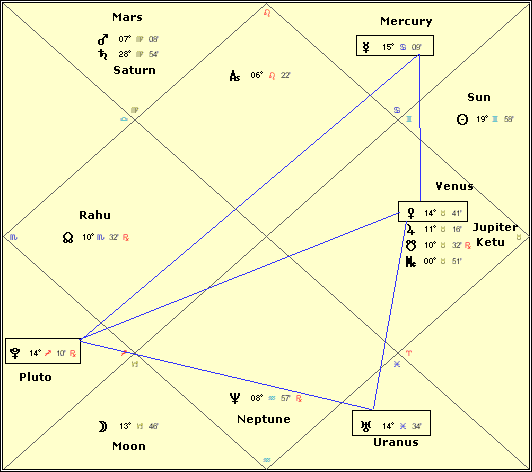
This week looks like it could bring some interesting developments.  There is powerful alignment of planets through much of the week that could move markets significantly.  The ongoing Uranus-Pluto square aspect is joined by both Mars and Jupiter this week.  The last time the Uranus-Pluto aspect was activated by a third planet was after the EU summit on June 29 when the market rallied strongly.  This occurred as the Sun lined up in a t-square with those two distant planets.  This time around Mars will assume the role of the Sun, and form another t-square.  Mars is more of a negative influence than the Sun, however,  so there is less reason to expect gains, at least in the early going.  Of course, Mars has the capacity to take the markets lower so that is definitely a possibility at some point.  However, the presence of Jupiter in the mix would seem to be more positive.  It forms a close aspect with Uranus later in the week which tends to correspond with gains. 

But even if we do happen to see some upside here, the clock would appear to be ticking on the market as Saturn approaches its entry into sidereal Libra on August 1.  This is usually a bearish influence.  Previous Saturn sign changes have corresponded closely with declines.  Saturn first went into Libra last November when the market dropped more than 10%.  As it moved backward through its retrograde cycle, it then entered Virgo in May and the market declined again.  Saturn's re-entry into Libra here is definitely not something to be taken lightly.


Saturday, July 7, 2012

Bad US jobs report links Obama to "zombie economy"

No matter how skilled a politician he may be, this week's poor jobs report has forced President Obama back on his heels.  Friday's weak US employment report showed only 80,000 new jobs were created in June, far below the +200K from earlier in the year.  The unemployment rate remained unchanged at a stubbornly high 8.2%.   The disappointing performance gave more ammunition to Republican Mitt Romney as a sign that Obama's interventionist Keynesian-style policies aren't working.  Things are getting so bad that some US media outlets are now started to refer to the "zombie economy" which is effectively dead.  If that term gains traction, it would be very difficult for Obama to overcome the label and win in November.  While I am fairly pessimistic about the prospects for the economy, I do think Obama will prevail in the election.  That suggests there may be other factors involved in his victory over Romney.

There was more bad economic news as we had no less than three different attempts to stimulate the flagging global economy as central banks in China and Europe both cut their interest rates, while the Bank of England undertook a new round of quantitative easing.  Markets were less than enthused by these developments as the Dow fell almost 1% on the week closing at 12,772 while the S&P 500 finished at 1354.  Indian stocks fared better as investors anticipated an RBI rate cut later in the month.  The Sensex enjoyed modest gains closing at 17,521 while the Nifty ended the week at 5316.  While the week may have ended badly, stocks did make new highs along the way.  This positive result was in keeping with expectations as I thought that the midweek Venus and Mercury aspects would produce gains.


Clearly, the global economy remains as fragile as ever.  The sense of relief from the recent European bank bailout is fading fast as Spanish bond yields have crept back up to that critical 7% level.  The Euro is hitting new lows as it is trading below 1.23 against the US Dollar. China's rate cut was the second in less than a month and signals a growing risk of recession.  All of this uncertainty does seem like an appropriate reflection of the dominant planetary aspects that are active at this time.  The Jupiter aspect to the Uranus-Pluto square offers some prospects for gains in the short term but this will be a fairly quick alignment which may not correspond with a major move higher in the stock market. At the same time, Saturn is soon to re-enter the sign of sidereal Libra.  These Saturn ingresses are usually bearish and this could easily offset whatever positive energy may result from Jupiter's aspect.  As I see it, the more powerful Uranus-Pluto aspect undermines the possibility for any significant economic recovery any time soon.  This aspect just had its first exact aspect in June and will likely haunt the economy for the next two or three years.  We could see some solutions offered, but they are likely to be temporary.  Perhaps the US will follow in the footsteps of Japan and its "lost decades".  Like Japan after its stock market crash in 1990, the US is attempting to stimulate the economy through additional government spending.  While this will likely prevent a worst case depression scenario, growth may remain low for many years to come. 

This week looks like we could see more treading of water.  First off, there is a fairly nasty looking Mars aspect with Ketu, the south lunar node. This could manifest at any time in the first half of the week, although there is an argument to be made for Monday given the Moon's opposition to Mars at that time.  However, Mercury will be in aspect with Venus in midweek and after so that seems likely to correspond with some upside.  Jupiter also moves one step closer to its aspect with Pluto and Uranus so that adds to the bullish side somewhat.  Friday's session is more of a question mark since the Sun approaches its square aspect with bearish Saturn.  The aspect won't be exact but it may still disrupt the mood.  Gold may also suffer at week's end as a result of this Saturn influence on the Sun.


Saturday, June 30, 2012

Merkel blinks at EU summit; markets rally

Europe backed away from the abyss yet again as Friday's EU summit produced another bailout to solve its ongoing debt crisis.  Germany's Angela Merkel is widely seen as the loser in this struggle between southern debtors and northern creditors as Germany accepted the demands of Italy, Spain and France to share their debt burden.  Now the European Central Bank will be able to buy Spanish and Italian bonds as a mean to keep a lid of interest rates.  The ECB will also oversee an EU-wide banking regulatory agency in order to stem the banking crisis.  Spain's teetering banks will receive an injection of €120 Billion directly from the European Stabilization Mechanism (ESM), which is the latest incarnation of the EU's bailout fund.

Global markets cheered the news as the US stocks rose sharply and posted a 2% gain on the week.  After a mostly negative week, the Dow closed at 12,880 while the S&P 500 finished at 1362.  Indian stocks also shook off the doldrums as the Sensex climbed more than 2% closing at 17,429.  The Nifty broke above resistance and ended the week at 5278.  From an astrological perspective, the summit deal was a very appropriate reflection of the Uranus-Pluto aspect.  While I thought we might have seen a little more disruption and uncertainty in the run up to the deal, I did expect some kind of resolution to the crisis last week.  The twin stations of Venus and Saturn are often associated with market reversals so we did see an interim bottom in US and European markets.  And as I noted in last week's post, the Uranus-Pluto square aspect was indicative of some kind of fundamental disruption with the status quo and pointed to some major changes ahead.  As it happened, we did see the beginnings of a new EU emerge as a result of this summit, as the member states have forged an agreement towards closer integration.  The EU did not just throw more money at their problems but rather created a new banking regulator to ensure sounder lending practices in the future.  Also, Germany finally agreed to allow the buying of Eurozone debt by the ECB.  This had been a major sticking point since the Germans did not want to let their indebted members off the hook without strict austerity.  The EU may now be slowing evolving beyond a simple currency union into a more tightly knit economic and political federation.

Despite Germany's dominant position in the EU, it is widely seen to have caved into the demands of the other members in the interest of long term viability of the Eurozone.  Perhaps it was no coincidence that Germany also lost to Italy in the semi-finals of the European football tournament on the same day that the EU summit deal was struck. These patterns of fortune and luck tend to operate on many levels, perhaps as a reflection of planetary movements.  For her part, Angela Merkel is in a difficult spot these days as Saturn is stationing in close aspect to her Sun.  This can be an oppressive influence which lasts for many weeks due to the slower than normal motion of Saturn around its retrograde cycle.   Saturn transits to the Sun can erode self-confidence and drain the vitality of a person to take the initiative.  Merkel may well have simply lacked the fortitude to assert herself in the face of a more organized opposition from France, Italy and Spain.  From an outcomes perspective, Sun-Saturn transits tend to simply deny the wishes of a person and force them to accept less than they wanted.  It is a tough transit for everyone, even powerful leaders of large countries.  The fact that Merkel's Sun is tightly conjunct Uranus and square Neptune probably makes Saturn's influence that much more oppressive since more planets are involved with the transit affliction.


We can also see her probable frustration during this summit through the exact Mars square transit to her natal Mars.  This is usually a tough influence to handle and often correlates with unworkable situations, anger, and victimization by others.  It has been reported that Hollande (France), Monti (Italy) and Rajoy (Spain) essentially ganged up on Merkel and held the Germans hostage to their demands for debt sharing. With that strong Mars and Saturn influence in Merkel's chart, it was quite likely that their efforts would be successful.  Saturn's continuing slow velocity for the next month or two suggests that Saturn will continue to exercise a negative influence on Merkel over the summer. I would be particularly concerned of the effects on her when Mars and Saturn conjunct on or around 15 August.  This conjunction will form a very close square aspect to her Sun so she is more likely to confront intense and challenging situations around that time.

This week looks like we could see some follow through to Friday's rally.  Saturn's negative influence is receding here a bit as it moves forward while Venus will form aspects to Uranus and Pluto by midweek.  Mercury will join that favourable alignment on Tuesday and Wednesday so that is another potential source of optimism.  The early week conjunction of Jupiter with Ketu (South Lunar Node) may be somewhat unsettling, however, so that could correlate with some profit taking, perhaps on Monday.  Wednesday's US holiday closing suggests that gains may be more likely to occur on Tuesday or Thursday.


Saturday, June 23, 2012

Markets disappointed by Fed's extension of Operation Twist

Stocks generally moved modestly lower last week as the Fed disappointed some investors by extending Operation Twist. In New York, the Dow lost less than 1% closing at 12,644 while the S&P 500 finished at 1335.  In Mumbai, Indian stocks were mostly flat as favourable cues out of Europe shored up sentiment after the RBI decided to leave rates unchanged.  The Sensex ended the week 23 points to the good finishing at 16,972 while the Nifty closed at 5146. 

While I thought we might have seen a little more downside on the strength of the two Saturn aspects in play, the week unfolded more or less as expected.  I thought the early week Venus aspect could reflect a relative calm after the Greek election result and that is essentially what happened.  While the post-election relief rally quickly fizzled, at least the doom and gloom scenario of a anti-bailout Syriza win did not come to pass. I thought that the downside was more likely to arrive after the Wednesday Fed meeting and indeed the market sold off after Bernanke chose the more conservative option of Operation Twist instead of QE3.   This coincided nicely with the bearish Mercury-Saturn aspect and we got a big decline on Thursday with gold and oil also participating.

Europe remains the focus of the financial world this week as its leaders will meet in summit on Thursday and Friday.  Opinion is divided over whether they will  be able to deliver fresh solutions to the debt crisis, or even if the market needs them to do so.  Few are expecting a comprehensive program to emerge from the meeting, but the markets would like to see something tangible that goes beyond the usual boost in the size of the ESM and EFSF bailout plans.  It is fascinating to see how the current financial crisis is reflected in the planetary geometry.  Bearish Saturn is about to station and return to normal forward motion while disruptive Uranus makes its exact square aspects with power-hungry Pluto this weekend.  These are clearly troubled times in the financial world and the planets are echoing that reality.  Even more interesting is how the current crisis bears a resemblance to the European banking crisis of 1931.  At that time, there was a similar crisis of excess debt that bankrupted many banks in Europe and around the world.  Bank runs were common in 1931 as Austrian and Germany banks became insolvent in the face of an ever deepening depression.  It is not coincidental that we see some of the same planetary aspects then as we do now.  In 1931, there was also a rare Uranus-Pluto square aspect in play.  This wasn't quite exact yet, but it was still within just one degree.  It is worth pointing out that this Uranus-Pluto square aspect occurs only once every 70-80 years and the last time is happened was 1931-1933.  The planetary picture in the early 1930s was considerably darkened by the aspect from Saturn that formed a t-square with Uranus-Pluto.  Saturn is less prominent this time around as we can only point to a weaker 8th harmonic aspect, but it is still there.  This is perhaps one reason why the crisis so far has not been as bad as the 1930s. Of course, the Uranus-Pluto square lasts a long time so it will be in effect until 2014.


Transits for 1 August 1931

This week could bring some important new developments.  The Uranus-Pluto square is exact on Sunday and may be activated the Sun's transit on Friday the 29th.  This will form a very tense t-square aspect and could release some of that disruptive and disorderly Uranus energy. Since this happens on the same day that the EU summit is wrapping up, it is tempting to think about possible scenarios that could correspond to the symbolism of this aspect.  Since it does look tense, this would tend to support the view that the EU does not solve its problems this week.  Perhaps this means that pro-austerity Merkel holds out against all the calls by Hollande, the IMF and the ECB to stimulate the European economy.   And yet since these aspects are so close to exact, it also seems plausible that this week will bring some kind of resolution.  The markets may react negatively at first, but there is some reason to expect at least a temporary solution to come forth.  Before Friday's t-square, Saturn turns direct on Monday while in a very tight and potentially negative aspect with Venus.  For its part, Venus also turns direct on Wednesday, so this is another reason to be extra cautious here.  Planetary stations generally represent increases in energy which can accompany major developments and adjustments.  They are also partially correlated with reversals in market direction.


 Transits for Friday 29 June 2012 9.30 a.m. New York

Saturday, June 16, 2012

Greek election pushes Europe to the brink

The Eurozone debt crisis has reached its latest climax as Greece prepares to vote in an pivotal election on Sunday.  Historian Niall Ferguson is calling it the financial equivalent of the Cuban Missle Crisis.  A win by the leftist Syriza party could generate dire consequences for the Eurozone and the world's financial system.  Syriza has vowed to reject the austere EU bailout plan that was agreed upon last year.  If the bailout package was abandoned,  the EU's loans to Greece would soon end and the country would default on its debt in a matter of weeks. This would likely force several large European banks into insolvency since they are larger holders of Greek debt.  It would also hasten the departure of Greece from the Eurozone.  The most recent polls show Syriza in a tight race with the right of center and pro-bailout New Democracy party.  A win by New Democracy would be seen as positive for the Eurozone and would be cheered by financial markets.

This kind of high drama is precisely the sort of thing we were expecting here in June as a number of major planetary patterns are reaching their maximum intensity.  As I have noted previously, June stood out as a potentially tumultuous time because of the simultaneous occurrence of two fairly rare events.  First, there is a square aspect between Uranus and Pluto.   These distant planets are rarely in aspect with each other but when they do, big things happen.  Both planets are symbolically associated with change, albeit different types. Uranus tends to reflect situations of sudden and radical change which seek to establish independence and novelty.  It is seen as a planet of revolution.  Pluto's change is no less profound, but tends to change more deliberately and thoroughly through the exercise of power and manipulation.  When these two planets combine their energies, it can correspond with periods of major social upheaval.  The last time these two planets interacted was in the mid-1960s when society was undergoing a major social and cultural revolution.  It is worth noting that that was a conjunction.  The last time there was a Uranus-Pluto square aspect in the sky was in the early 1930s during the depth of the Great Depression and the rise of fascism and the welfare state.  The square aspect is seen as more difficult and disruptive than the conjunction so we need to be mindful of the possibility of some serious developments during the next two to three years.  Due to the slow velocity and retrograde motion of these planets, this aspect will be in effect until approximately 2015.  From now until then, there will be three exact aspects, the first of which occurs next week on 24 June.  

The second rare planetary pattern upcoming is a Saturn direct station on 25 June (yes, just a day after the Uranus-Pluto square!) while in a close 135 degree aspect with Venus.  Saturn is best understood as the planet of pessimism and caution.  Its station marks the end of its four-month long retrograde cycle as it reverses direction from backwards to forwards.  Saturn is therefore more powerful at this time and has more ability to do harm and weaken confidence.  To top it all off, Venus itself will end its retrograde cycle on Wednesday the 27th and this will also be an additional source of energy. 

So the planets are very much reflecting the intense and historic nature of the events on Earth at the moment as the world may be teetering on the brink of another financial disruption that could set off a chain reaction with unpredictable consequences.  Of course, we want to know what the outcome will be to all this intense build-up of energy.  Will we return to a state of relative calm in the aftermath of the Greek election or will the situation worsen after a negative result?  To state the obvious, there is no clear scientific way to interpret the impact of planetary patterns.  Have the negative effects of the current aspects already manifested in the form of uncertainty and the recent weakness in the Euro and the markets?  Or are more negative manifestations likely in the near term?  It's hard to say for sure, but my sense is that these aspects should coincide with more difficult situations for Europe and the financial markets in the coming days.  Given the nature of the planets involved in these aspects, there is a rising possibility for more serious outcomes.

Stocks rose last week as the IMF promised a coordinated central bank intervention in the markets in the event of an unwelcome result in the Greek election.   In New York, the Dow was higher by more than 1% closing at 12,767 while the S&P 500 finished at 1342.  Indian stocks also rose on hopes of an RBI rate cut on 18 June.  The Sensex rose more than 200 point closing at 16,949 while the Nifty ended the week at 5139.  While I was somewhat ambivalent, this bullish outcome was not surprising as I thought the presence of the favourable Mercury-Venus aspect could well push stocks higher overall. 

This week appears to have Saturn in the driver's seat as it forms aspects with Mars and Mercury. Saturn aspects are usually bad news for markets since it tends to reflect caution and disappointment.  The Mars-Saturn aspect is exact on Monday but since it is a minor aspect it may be less damaging.  More troubling is the Mercury-Saturn square aspect on Wednesday and Thursday.  This is a bearish influence can could coincide with some significant disappointment.  Given the Fed meeting on Wednesday, there is a greater chance that investors will be disappointed in what Bernanke has to say.  Perhaps he will not be announcing any QE3 or an extension of Operation Twist.   The early week also features a fairly nice looking configuration of bullish Venus with Uranus and Pluto.  That is one astrological reason why we may not see a huge sell-off on Monday and the possibility for a status quo result in Greece.  At the same time, it is important to note that if the election is close, it may be several days before we know who will be leading the government as the parties attempt to cobble together a coalition.


Saturday, June 9, 2012

Stocks rise on hopes for Spanish bailout

Stocks enjoyed their best week of 2012 on indications that some kind of solution could be found to the Spanish banking crisis.  In New York, the Dow climbed more than 3% closing at 12,554 while the S&P 500 finished the week at 1325.  Indian markets fared even better as the Sensex rose more than 4% closing at 16,718 while the Nifty ended the week at 5068.  As expected, most of the gains occurred midweek around the Sun-Venus conjunction and the Mercury-Jupiter aspect.   Monday's tense Mars-Venus aspect coincided with some significant bearishness, although markets generally rebounded before the close.

Spain's banking crisis reached a critical point last week as talks are now underway for an EU bailout.  The IMF estimates that Spanish banks may need up to €40 Billion to cover their loan losses. While bond yields have backed away from the precipice, they remain elevated above 6% reflecting their significant credit risk.  The enormity of the European financial crisis cannot be underestimated as it threatens to bring down the global economy. President Obama's re-election chances are closely affected by the crisis since the state of the US economy is the central issue in the upcoming November vote.  As Europe goes, so goes the US.  Not surprisingly, Obama encouraged European officials to do whatever was necessary to prevent the crisis from getting out of hand.  

Common sense would suggest that a solution will be forthcoming very soon, and the market rally last week reflects this reasonable expectation.  No matter how divergent the interests of the key players, the seriousness of the problem should compel policymakers to arrive a workable plan.  Failure to do so could spark a Lehman-style panic that we saw during the meltdown in 2008.  But not all solutions are created equal, so there could be a range of market reactions to whatever the final agreement will be.  The EU has faced similar crises in the past two years and have always managed to come up with something, although these tended to be temporary solutions that only postponed the inevitable day of reckoning.  We may well get another postponement type of package this time around. 

The trouble with all these sensible expectations is that they do not fit with the planetary picture at the moment.  Basically, the planets don't look good right here so I am expecting some kind of disappointment or surprise to throw a wrench into all those best EU intentions and economic rationality.  It could be that the bailout package is underwhelming and the markets decline in reaction.  Or it could be that the bailout is welcomed by all parties, but then Greek voters elect an anti-austerity government on 17 June.  Greek remains the wild card here since an anti-austerity vote would force the EU to implement radical firewall measures to prevent the banking crisis from deepening.  With Saturn and Venus due to station in the last week of June, I would say the markets will have to run the gauntlet in the aftermath of the Greek election.  And with the disruptive Uranus-Pluto square in the mix, there is the potential for some fundamental changes to the financial system.  As we know, nothing is certain in this world, much less astrology, but the planets here are suggesting a situation of rising risk.

We will get a taste of the effects of the Uranus-Pluto square early this week as Mercury forms an alignment with that pairing on Monday.  This t-square pattern is usually negative. The Sun and Saturn also form an aspect in the early week which could be problematic, especially for gold.  Perhaps gains are more likely midweek near the Mercury-Venus aspect, although this does not look particularly strong. Oil may receive a boost this week from the transit of the Moon in Pisces.  Even if the market ends higher this week, it may well be temporary.


 Transits for Monday 11 June 2012 9.30 a.m New York