Monday, December 30, 2019

The 2020 New Year's Horoscope

(30 December 2019) With the coming of the New Year, we may try to see what may lie ahead for 2020.   The New Year's horoscope is an intriguing and simple way to see possible themes and trends.  This horoscope is a chart cast for the first minute of the New Year, at midnight on January 1.  As a default location, I choose Washington, DC but other locations may also be chosen.  Nonetheless, the Ascendant is always somewhere in the middle of sidereal Virgo, although the exact degree rising can vary somewhat.  While the New Year chart does not correspond to any particular astronomical event, the symbolic importance of the first moment of the New Year can yield important clues about the year upcoming. 

For example, years that are marked by recession and wars tend to have malefic planets in prominent places in the chart.  Thus Mars, Saturn, and the lunar nodes, Rahu and Ketu, are often stronger if they align with the Ascendant, Sun or Moon and other planets.  This happened most recently in 2008, the year of the Great Recession, when the 12th house Saturn was aligned with the Sun, while Mars was opposite Pluto, Jupiter and the Sun.   It was not a good chart. (see below)

This year the New Year's chart doesn't look quite that bad.  And yet I would say that the chart suggests we could see increased instability and change.  One main reason is due to the prominence of the Lunar Nodes, Rahu and Ketu, at the top and bottom of the chart.   Rahu near the 10th house cusp suggests unexpected or disruptive events relating to leaders and governments.  This could represent some major governments failing or being voted out of power. 
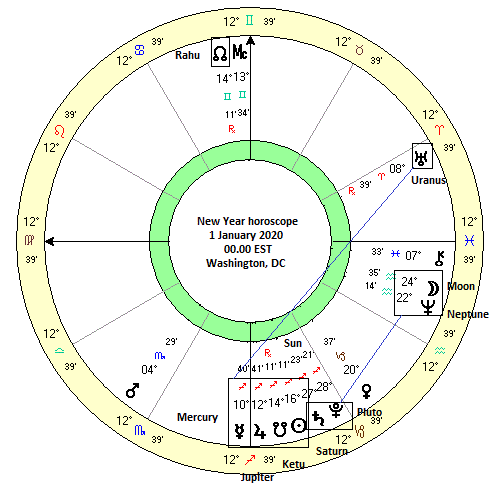


The nodal influence is made even greater due to Ketu's close conjunction with Mercury, Jupiter and the Sun, and more widely, with Saturn and Pluto.  Ketu's conjunction with the Sun reinforces the notion that leaders and government will become more unstable this year.  The Ketu influence on the Sun typically undermines notions of power and ego.  This is perhaps a comment on the fallout from the Trump impeachment proceedings and the upcoming US election in November. 

Ketu's conjunction with Mercury and Jupiter looks more positive as breakthroughs in science and communication are more likely.  The trine aspect with Uranus amplifies this sense of discovery.  Of course, the accelerating progress of science and technology is one of the hallmarks of this century.  But this pattern is unique and suggests that 2020 will be a year of major technological innovations and discoveries. 

Besides suffering from potential governments disruptions, there are a couple of alignments that deserve special mention.  First, Saturn is conjunct Pluto within one degree.  This combination can reflect intense situations of restriction and austerity.  Saturn also connotes onerous and disciplined labour with may be coerced in some way  Manipulation by authorities is another theme that captures some of this difficult Saturn-Pluto dynamic.

The second pattern is the Moon-Neptune conjunction.  In its more hopeful form, this pairing suggests spirituality and inspirational visions, such as one might associate with a period of religious flowering or renewal.  However, we should note that the Moon-Neptune combination is closely aspected by Saturn through its full strength 3rd house aspect.  This is a serious affliction that will tend to reduce the positive spiritual manifestations of Moon-Neptune and bring forth its more malefic qualities.  These may include disappointment, delusion and sadness, since the Moon is the planetary significator for the emotions.  This is therefore a potential indicator for generally pessimistic sentiment which could reflect a slowing economy. 

I would also suggest that the affliction of Moon-Neptune by Saturn could signify some kind of disease or health-related problems in 2020.  Neptune is the planet that is frequently connected with illness so its connection with Saturn and the Moon is noteworthy.  Saturn rules the 6th house of health so its association with Neptune and the Moon also raises this as a possible scenario.  By way of comparison, the SARS outbreak in 2003 saw Neptune closely aspected by Rahu in the New Year's chart, while the Moon was closely opposes by Saturn. 


Overall, 2020 looks like it will be an eventful and challenging year on several fronts.  The economy may be an ongoing source of concern but the indications are not as strongly negative as they were in 2008.  This may be suggest that the economy will fare somewhat better, however, we do need to remember that the New Year's chart does not have the final word.  It often operates in broad strokes and in a more impressionistic manner than specific charts relating to financial markets or the fate of specific governments.  Therefore, we will fill out our analysis in the coming weeks and months as events develop. 


Weekly Market Forecast

Financial markets have enjoyed the typical Santa Claus rally as the year wraps up.  As I suggested previously, the end of the year looked fairly positive as the Christmas eclipse occurred with a bullish conjunction of the Sun and Jupiter.  That said, I had been a bit uncertain if the stock market would manage to stay buoyant to the end of the year in the wake of the Jupiter-Uranus-Chiron alignment that had underwritten much of December's rally.  Stocks pulled back somewhat today (Monday) but most indexes are trading very close to their all-time highs. 

This week has a good chance for more upside, perhaps as soon as tomorrow (Tuesday).  Mercury is due to conjoin Jupiter by Thursday so that is likely to coincide with at least one up day (especially on Thursday, Jan 2) although I suspect its positive influence may be felt beforehand.  Friday looks like more of a question mark, however, so bullish investors should be careful. 

For a more detailed analysis of the markets, please check out my weekly subscriber newsletter which is published every Saturday afternoon (EST).   I outline the key technical and planetary influences for US and Indian stocks for the short and medium term, as well as currencies, gold and oil.


Monday, December 16, 2019

US-China trade deal sparks Santa Claus rally ahead of Christmas eclipse

(16 December 2019) Investors breathed a sigh of relief after the tentative agreement of the Phase 1 US-China deal late last week.  While there still seems to be some uncertainty surrounding the details of the deal, financial markets finished mostly higher.  In addition, the Fed delivered a dovish statement in its Wednesday FOMC meeting and the UK's Boris Johnson won a large majority in Thursday's election.  These were also bullish developments that helped boost stocks to new highs.

The gains did not significantly diverge from my expectations.  The ongoing Jupiter-Uranus-Chiron alignment was likely to provide a floor for stocks in any event although the bearish Venus-Saturn transit influence did not coincide with much downside.  I had been uncertain about the outcome of the US-China talks as the planetary indications were decidedly mixed although I thought a minor deal was quite possible.  While we have seen a largely positive reaction so far, the optimism could dissipate rapidly as we have seen so many times before in this ongoing saga.

With recession fears diminishing somewhat in recent weeks, the consensus view for stocks is mostly bullish as we finish up 2019 and head into 2020.  I'm far less sanguine, as the bullish Jupiter influence is waning as we approach the holiday season just as Saturn's bearish influence is likely to become more apparent.


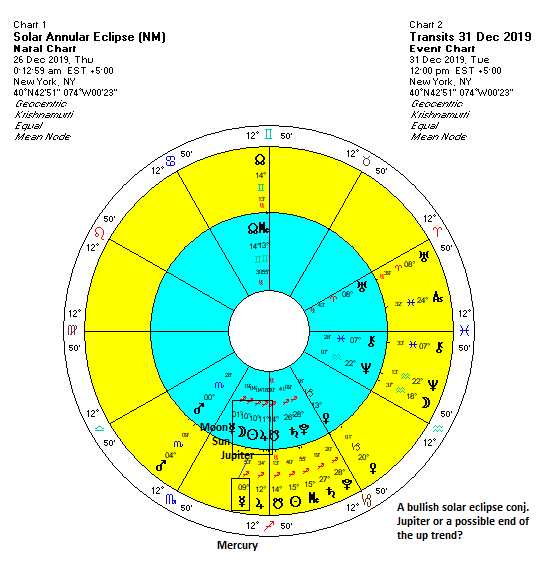
One possible turning point in that respect is the upcoming Solar Eclipse that takes place shortly after Christmas Day, at twelve minutes past midnight (EST) on the 26th to be exact. Eclipses can have powerful effects on the markets -- and on our lives in general -- although they usually don't manifest until several days or weeks after the event.  We saw a near-immediate reaction to the lunar eclipse of January 31, 2018 as global markets declined sharply in the days following and thus began an extended period of volatility that would last for months.  Stocks also sold off sharply just two weeks after the lunar eclipse of July 16, 2019.  This is a more typical time lag between the eclipse and the market reaction, whether bullish or bearish. 

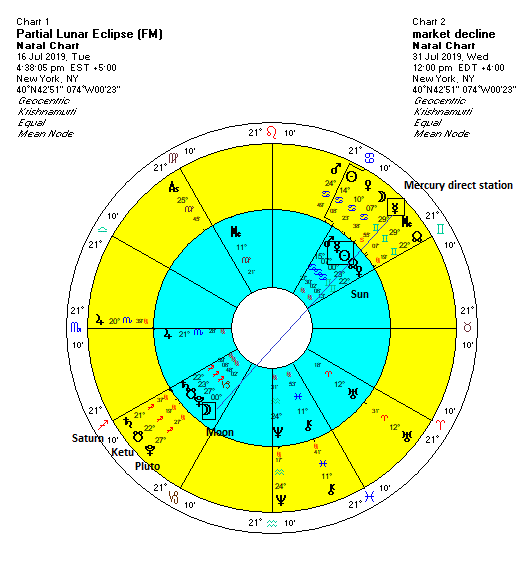
Eclipses usually need their energy to be released or triggered by a faster-moving transiting planet like Mars or Mercury.  We can see that the week-long 6% sell-off that began on July 31, 2019 coincided with Mercury stationing direct at 29 Gemini almost exactly opposite the lunar eclipse point at 0 Capricorn.  As I have discussed previously, Mercury stations (retrograde and direct) more often coincide with major moves, both positive and negative.  While other factors played a part in the decline, the Mercury station to the lunar eclipse point was a probable triggering factor. 


This upcoming Christmas solar eclipse will be closely conjunct Jupiter in the Sagittarius.  As configurations go, that is quite positive all other things being equal.  One possible interpretation is that it could mark the proximity of a major high point in the market.   A solar eclipse that conjoins Jupiter could mean that this is "as good as it gets".   Mercury will then transit across the eclipse point of 10 Sagittarius on December 31 so that is another plausible high water mark to consider.  That said, I'm still not sure stocks will continue to rally through to the end of the year.  Certainly, the typical Santa Claus rally around the holiday season tends to lift stocks and that could well happen again this year.  But there are likely to be some noteworthy down days along the way over the next two weeks that could make things difficult for bulls.  

While eclipses can be both bullish and bearish depending on the relevant alignments at the time, it should also be noted lunar eclipses carry more downside risk than solar eclipses.  The next lunar eclipse occurs on January 10, 2020 and may well be in closer proximity to trouble for the markets.  Saturn is more prominent in early 2020 as it will be conjunct Pluto in January and then due to enter sidereal Capricorn in late January and early February.  This Saturn influence is likely to represent a shift in sentiment in the financial markets as we begin 2020.

For a more detailed analysis of the markets, please check out my weekly subscriber newsletter which is published every Saturday afternoon (EST).   I outline the key technical and planetary influences for US and Indian stocks for the short and medium term, as well as currencies, gold and oil.

Monday, December 9, 2019

Trump impeachment draws nearer

(9 December 2019)  The impeachment juggernaut is moving ever-closer to its ineluctable conclusion.  House Democrats are promising a vote on the Articles of Impeachment as soon as next week as Congress prepares to take a break for the Christmas holidays.  While there is still some uncertainty about its exact timing, the Senate trial of President Donald J. Trump would likely begin in January.  A vote to convict would then take place several weeks later at the earliest, perhaps in late January or more likely in February or even as late as March depending on the length of the trial.

Despite the high-stakes proceedings, few people expect Trump to be convicted by the Senate.  It is more likely that the impeachment vote will follow party lines with the Democrat-controlled House voting to impeach much like the GOP-controlled House voted to impeach Bill Clinton in December 1998.  The Senate vote to convict in February 1999 did not pass and largely followed party lines since the GOP lacked the 67 seats out of 100 needed.  The Democrats have 45 seats and would need 22 Republicans to vote against Trump to convict him.  A tall order, to say the least.

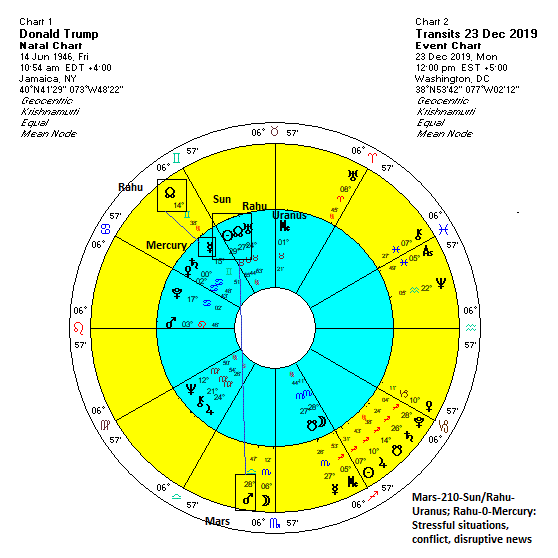
That partisan scenario may well play out again this time, although the Trump's horoscope does seem to be heavily afflicted in December and even more so in early 2020.  In late December, we can see that transiting Rahu will conjoin Mercury which could bring disruption, deception and confusion, especially in areas of communication.  Mars will aspect his Sun-Rahu-Uranus conjunction just before Christmas suggesting a time of elevated stress and conflict.  Given the current timetable, that could represent the House passing its impeachment vote. 

But losing the House vote is almost a forgone conclusion.  But if Trump was going to win the Senate vote (i.e. less than 67 votes for impeachment), we should expect to see more positive active influences in his chart in early 2020.  And yet this isn't really the case.  This is one reason why I cannot rule out the possibility that Trump will either be removed from office or avoid the whole process and resign.


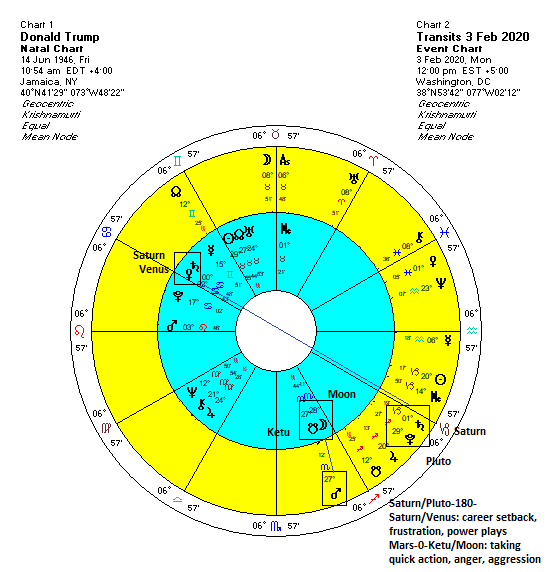
As I noted in October, Trump will likely suffer significantly from the transit of Saturn and Pluto which oppose his natal Saturn (0 Cancer) and Venus (2 Cancer) in February and March.  February's Saturn opposition to Saturn-Venus will coincide with a bad Mars transit, that of the conjunction with his Moon-Ketu conjunction in late Scorpio.  Could that possibly symbolize the Senate voting to convict him and thereby removing him from the Presidency?  It still seems unlikely even with these bad transits although it is clearly not a good planetary situation.  One thing that seems clear is that it does not look like a cut-and-dried Trump win in the Senate that the GOP is hoping for.


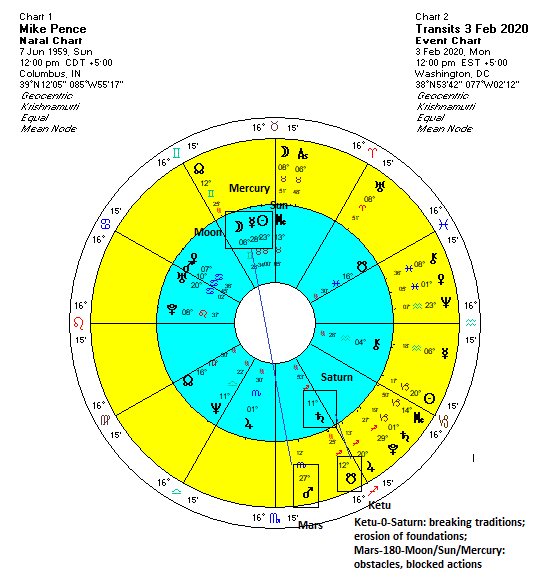
Another angle on this question involves the chart of Vice-President Mike Pence.  If Trump is impeached and convicted in 2020, then Pence's chart should be positive since he would become president.  But that also isn't clearly borne out by his horoscope, although we should note we do not know his birth time so the margin of error is larger than normal here.  In fact, Pence's chart in early February also looks afflicted as Ketu conjoins his Saturn (erosion of foundations; breaking traditions) and Mars opposes his Sun-Mercury-Moon conjunction.


So it may well be a stressful time for him also.  On reflection, that may not be surprising, since Pence likely lacks any independent power base in the GOP.  It is largely Trump's party so if he is forced out, Pence will be in a difficult position. Trump may well want to continue to exert control over the White House after he has left office.  Therefore, we can't simply assume that Pence will be fully independent. 

And if Trump wants to run for re-election in the event of his resignation/conviction, he may well be able to do so.  If he chooses to resign before the Senate conviction vote, then he may be legally entitled to run for the GOP nomination in July.  Needless to say, 2020 is bound to be an interesting year.  I will update the whole Trump situation as it evolves.


Weekly Market Forecast

Stocks quickly recovered from last week's brief sell-off as Friday's jobs report came in above expectations.   Both the early week selling and late week rebound were in keeping with the prevailing planetary influences. The Mars-Venus-Rahu alignment in the first half of the week indicated the probability of some downside while the late week Moon alignments with Jupiter and the Sun suggested more optimism and rising stock prices.

Investors this week will be focused on the Fed meeting on Wednesday so we could see a reaction either way.  While sentiment is still supported by the ongoing Jupiter-Uranus-Chiron alignment, it is less clear how much purchase this pattern will have this week.  Tuesday has both positive (Mercury-Jupiter) and negative (Venus-Saturn) alignments in play while the Sun-Venus-Saturn alignment may predominate after Wednesday.   Saturn alignments have an in-built bearish bias, although they do not always correspond to declines.  Nonetheless, caution may be on the rise this week.

For a more detailed analysis of the markets, please check out my weekly subscriber newsletter which is published every Saturday afternoon (EST).   I outline the key technical and planetary influences for US and Indian stocks for the short and medium term, as well as currencies, gold and oil.


Monday, December 2, 2019

Dead or no-deal: US and China face Dec 15 tariff deadline

(2 December 2019) With the December 15 tariff deadline looming, financial markets are again contemplating if the US-China trade deal is half-full or half-empty.  A limited Phase 1 deal was supposedly in the bag in October, only to be undone by the usual cycle of fractured public negotiations on Twitter.  President Trump's support for the Hong Kong protestors angered China over the weekend and has made short term prospects worse.  So will Trump postpone these December 15 tariffs in order to keep the deal moving forward?

Both sides have cards to play.  Trump knows the trade war is probably hurting China more than it is hurting the US so China may be more willing to make a deal on terms favorable to the US.  However, China knows that Trump is in trouble politically with impeachment and with the election coming in November 2020.  Trump needs the stock market to be at or near record highs in order to have a decent chance of winning.  Failure to make a deal with China will cause stocks to fall so China may choose to wait Trump out until he caves. 

As I noted in last week's post, there is good reason to be more cautious about the stock market in the coming weeks.  The planetary influences are gradually shifting from a mostly bullish pattern to a more bearish pattern here in the month of December.  The very bullish alignment of Jupiter, Uranus and Chiron forms its closest angles in mid-December right around the time of the next Fed meeting on December 11, and this potentially pivotal trade deal deadline on December 15.  Once the alignment begins to separate, the risk of a market decline increases.

So there is a possibility of disappointment here right around the time of the trade deadline.  I am reluctant to make a firm prediction in that regard, although I do think that stocks will become more vulnerable around that time and in the days leading up to Christmas.  The second half of December will see bullish Jupiter weaken through its conjunction with Ketu (South Lunar Node) while bearish Saturn become more dominant as it approaches its conjunction with Pluto in January.


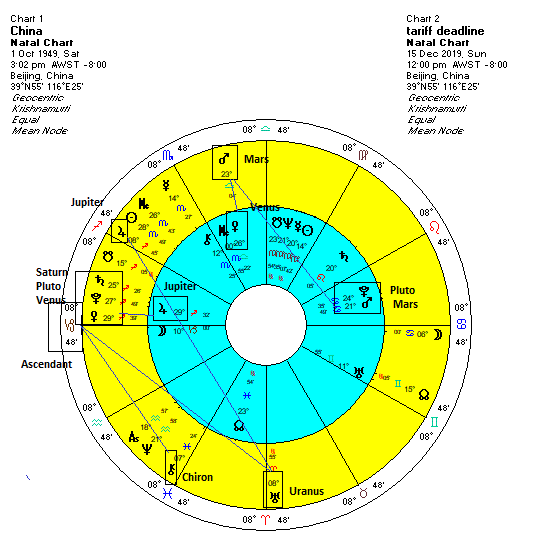
If we look at the horoscope of China (1 October 1949), we can see some significant aspects around the time of the deadline. On the plus side, the Jupiter-Uranus-Chiron alignment will highlight the Ascendant at 8 Capricorn.  This augurs well for the country as a whole, although it may not be relevant for the trade deal specifically.  The triple conjunction of Saturn-Pluto-Venus is conjunct the natal Jupiter at 29 Sagittarius.  The Venus hints at positive and constructive developments, but the presence of Saturn in the mix is not good.  It may not be a deal-breaker, but it may undermine the sustainability of any deal.  Also, transiting Mars will be conjunct Venus, the planet of diplomacy and agreement so that is a clear negative factor.

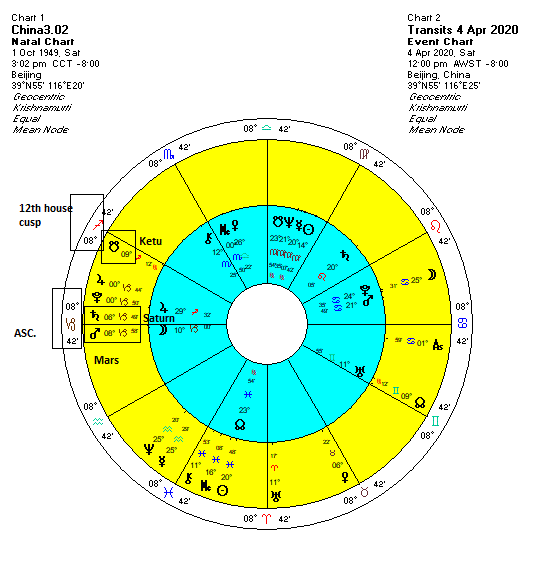
Overall, these alignments suggests a major positive breakthrough is unlikely although some minor deal is still quite possible.  The negative Mars and Saturn influences here are significant, although they may pertain to some other area such as Hong Kong, rather than the US trade deal.   Nonetheless, the outlook looks worse in early 2020 as Saturn and Pluto will conjoin Jupiter more closely and then move on to hit the Ascendant.  A particularly nasty configuration occurs in early April when Saturn and Mars conjoin the Ascendant while Ketu conjoins the 12th house cusp.  It is hard to see the Chinese economy and stock market doing well with these sorts of transits in effect. 


This suggests that China's economy will continue to struggle in 2020 and that growth could slow further.  The constraining Saturn influence on Jupiter (growth) and the Ascendant (the nation as a whole) may well mean that China could slip into recession.  Of course, official GDP data still forecasts 6% growth in 2019 although most observers see this data as manipulated and inflated.  Other data point to more serious problems in the Chinese economy.   


Weekly Market Forecast

Stocks have started off the week with a decline on renewed trade jitters and some underwhelming US factory data.  The decline coincided with a close alignment of Mars (mostly bearish) with Rahu (sometimes bearish) and Venus (mostly bullish).  We could see more downside over the next couple of days as Mars will remain in close aspect with Rahu.  But the second half of the week looks more positive as the Moon first aligns with Jupiter on Thursday and then with the Sun on Friday.  Maybe this unstoppable rally in US stocks isn't done yet.

For a more detailed analysis of the markets, please check out my weekly subscriber newsletter which is published every Saturday afternoon (EST).   I outline the key technical and planetary influences for US and Indian stocks for the short and medium term, as well as currencies, gold and oil.
Monday, November 25, 2019

The bigger the bubble, the bigger the bust

(25 November 2019) As investors put a positive spin on the Fed's recent interventions, stocks have resumed their upward climb this week.  Global markets rallied again on Monday after some brief consolidation last week.  As it happened, the pullback coincided closely with the end of the Mercury retrograde cycle on Wednesday.  This was in keeping with expectations as I noted that Mercury's direct station would occur in close aspect with Rahu, the North Lunar Node.  According to the principles of financial astrology, Mercury-Rahu alignments tend to be bearish.  Monday's gain was also not surprising given the bullish Venus-Jupiter conjunction.

It seems the sky's the limit now as fundamentals like corporate earnings and macro economic data are no longer important.  What matters now is that the Fed is underwriting US bank lending by conducting $100 Billion or more in "overnight repos" and buying $60 Billion a month in Treasury Bills.  After an unheralded beginning in October, these interventions amount to a new QE program (now variously called notQE or QE4) as the Fed tries to entice more lending in an effort to prevent the economy from slipping into recession.

As the old saying goes, the bigger the bubble, the bigger the bust.   The planetary alignments in the coming weeks suggest the good times may not last much longer.  As I've noted previously, the upcoming Jupiter-Uranus-Chiron alignment in mid-December should coincide with at least some further gains in the stock market.  Jupiter alignments with the outer planets have a fairly good track record of generating some upside.  However, the optimism may not linger for long as the upcoming conjunctions of Jupiter-Ketu and Saturn-Pluto both suggest a sharp reversal in sentiment as we move towards the New Year in 2020. 

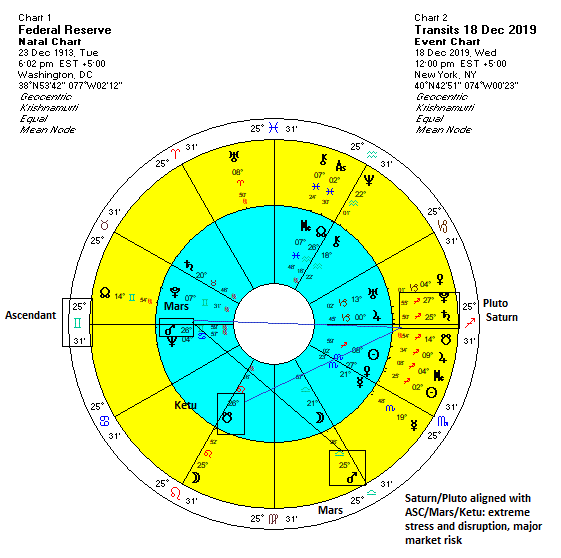
These conjunctions are themselves bearish, but we can also see how their negative impact will likely be felt in the horoscope of the Federal Reserve.  In the Fed chart, the planetary affliction is simple and profound.   In mid-December, Saturn (25 Sagittarius) will oppose natal Mars (26 Gemini) and fall under the aspect of Ketu (26 Leo).  This is a very tense and difficult alignment, perhaps even more so since Saturn is parked closely to Pluto (27 Sagittarius) and both will be opposite the Ascendant (25 Gemini) in the natal chart. 


As a possible triggering planet, transiting Mars (25 Libra) will align with Saturn, Rahu and natal Mars during the week of Dec 16-20.  I'm still uncertain exactly when the negative impact of these alignments will be felt as the high risk time window stretches from early December through January.  But the week that follows the next Fed meeting on Dec 11 it definitely worth keeping an eye on as a potential catalyst.  Saturn will remain within range of both Mars and Rahu for the rest of December. 

While it is possible that this kind of planetary affliction may not have any real world manifestation,  it seems much more likely that the Fed will be scrambling in December and probably into January as Saturn then conjoins natal Jupiter at 0 Capricorn.  Whatever the proximate cause of the disruption to the status quo, the Fed will be hard pressed to stay on top of it.  Markets are therefore more likely to be vulnerable to declines. 

With a recession still looking more likely than not in 2020 as Jupiter conjoins Saturn, this could be the beginning of a more difficult year in financial markets.

Meanwhile, this week could see some profit-taking ahead of the US Thanksgiving holiday on Thursday.  Tuesday's US trading session features a New Moon that aligns with bearish Mars so that is an elevated downside risk.   Nonetheless, I would not be surprised if the rally has a bit further to run as we go into December.

For a more detailed analysis of the markets, please check out my weekly subscriber newsletter which is published every Saturday afternoon (EST).   I outline the key technical and planetary influences for US and Indian stocks for the short and medium term, as well as currencies, gold and oil.
Monday, November 18, 2019

UK PM Boris Johnson looks poised to win re-election

(18 November 2019) We are still three weeks away from the UK election on 12 December, but it seems that Conservative Party leader Boris Johnson is poised to win.  Recent polls show the Conservatives with a healthy 10-12 point lead over Jeremy Corbyn's Labour Party with both the LDP and Brexit Party trailing far behind.  It would seem that the election is Johnson's to lose at this point. 

The Pound and UK stock market have been rallying in recent days in anticipation of a Conservative victory.  A majority government would finally end the uncertainty over Brexit and secure Johnson's October deal with the EU. 

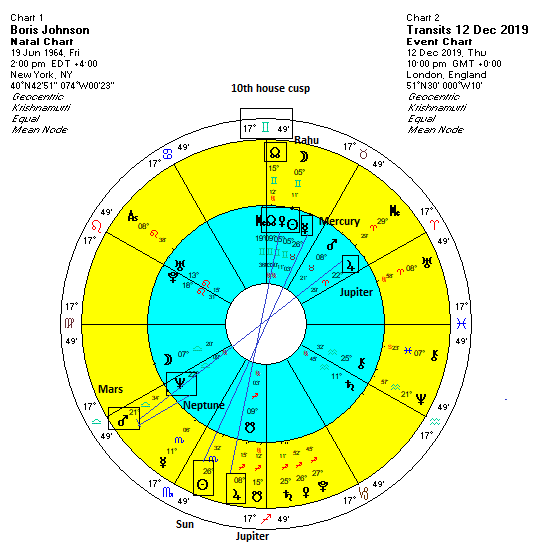
As I have previously stated, I think Boris Johnson is very likely to win this election.  He will begin his Mercury-Venus dasha period just four days after the election indicating generally positive outcomes for him over the next three years.  Both Mercury and Venus are benefic planets, and both enjoy favourable placements in his chart.  Mercury is ruler of his 1st and 10th houses and placed in Taurus in the 9th house of law and good fortune.   Venus rules the 2nd and 9th houses and is well placed in the 10th house of status conjunct the Sun and Rahu in Gemini.  Moreover, Mercury and Venus exchange signs and thus create an even more powerful interaction during this three-year dasha period.


On election day, Jupiter will be opposite his Venus-Sun in the 10th house thus giving him a boost in status.  Transiting Sun will be opposite his Mercury which should also be seen as generally positive.   However, Rahu will conjoin the 10th house cusp and eventually Rahu's natal position in late February.  While Rahu may have a troublesome side, it tends to do well in the 10th house so I would see this Rahu influence as a plus, although it could also correlate with some unexpected and complicating developments.  It may somewhat increase the odds for a minority "hung" parliament in which the Conservatives do not win more than half the seats.  The Mars transit to Neptune and opposite Jupiter is also a bit suspect and may not adhere to a classic script of a clear victory. 


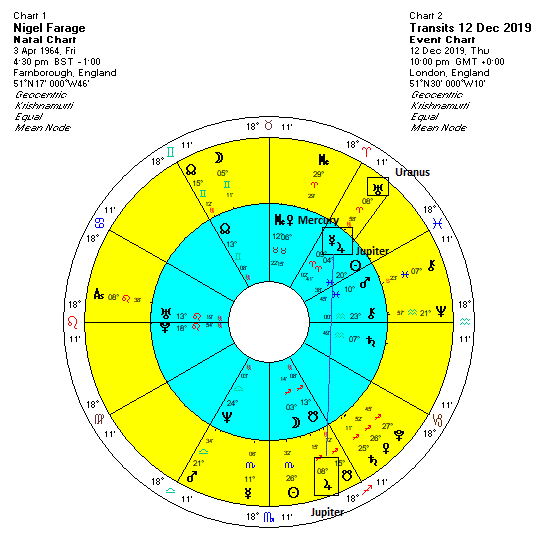
We can see a possible problem here when we look the chart of Nigel Farage, the leader of the Brexit Party.  While Farage has agreed to not contest Tory-held seats, his Brexit Party could play an important role in the event of a minority government.  Farage's chart is actually fairly good as the Jupiter-Uranus alignment lines up quite nicely with his natal Mercury in the 9th house.  Whatever the result, this pattern suggests that Farage stands to gain somehow around the time of the UK election. 

An obvious interpretation would be that his Brexit Party holds the balance of power after December 12th.  Or maybe he is just happy that Boris Johnson wins so that Brexit is finally done.  That seems like a bit of a stretch since he is not a big fan of Boris Johnson and his deal with the EU.  Other manifestations are also possible given the many layers of intrigue and influence that are at work behind the scenes in the UK these days.  In the longer term, Farage seems unlikely to wield much power.  He is running the Rahu-Saturn dasha now which is usually not very auspicious. 

Overall, Boris is likely to be returned as Prime Minister but there is a risk that he will not win an outright majority.  This could then extend the Brexit uncertainty all over again, although one would think that Farage's Brexit Party will be a more willing and cooperative coalition partner than the DUP was in the previous Parliament with Theresa May. 

Remainers do not have the stars on their side here.  Corbyn's horoscope doesn't seem very strong.  We have only an approximate birth time for him so I am reluctant to read too much into it.  Nonetheless, it doesn't suggest some sudden reversal of fortunes for him. 


Weekly Market Forecast

Stocks have generally continued their melt-up over the past two weeks as the recent Fed interventions in the market have encouraged more money to flow into risky assets like equities.  Previously, I had expected some upside from the entry of Jupiter into sidereal Sagittarius in early November.  However, I had been uncertain how long this boost would last.  Indian and Chinese stocks have gone sideways or down since that early November Jupiter ingress.  It still seems more likely than not that US and European equities will pullback this week and next although December still offers some upside hope to the bulls given the Jupiter-Uranus-Chiron alignment in the middle of the month. 

Mercury completes its retrograde cycle on Wednesday this week so there is some downside risk there.  These Mercury direct stations are not bearish by nature but this time Mercury will align with Rahu which is a more problematic combination.  Bulls should be therefore be careful.   Both Tuesday and Wednesday are more vulnerable to declines than they otherwise would be.

For a more detailed analysis of the markets, please check out my weekly subscriber newsletter which is published every Saturday afternoon (EST).   I outline the key technical and planetary influences for US and Indian stocks for the short and medium term, as well as currencies, gold and oil.
Tuesday, November 5, 2019

New highs for US stocks as Jupiter enters Sagittarius

(4 November 2019) Stocks are looking good to start the month of November as the Dow made a new all-time high on Monday.  Trade optimism is in seemingly endless supply as investors are still receptive to all the jawboning coming out of the White House.  And with the Federal Reserve now quietly engaging in its 'not-QE' program of asset purchases, there are more reasons (like $60 Billion per month) to think that stocks could stay in rally mode a while longer.  Never mind that year-on-year US corporate earnings are negative for Q3 and ISM manufacturing data showed a contraction for the third straight month in October.   

After the Fed's widely-anticipated rate cut last Wednesday, the market declined on Thursday just as Mercury turned retrograde.  This was in keeping with expectations since the retrograde stations of Mercury tend to have a bearish bias.  However, Friday saw a strong rebound which continued into Monday's session. This weakens the case for a protracted or deep pullback during the Mercury retrograde period that runs from Oct 31 to Nov 20. 

As I noted last week, while the three-week long Mercury retrograde cycle has a bad reputation for disruption, confusion and miscommunication, its most difficult times are the few days around the retrograde and direct stations themselves.  A trend change is also somewhat more likely around the stations. In this case, that seems less likely since stocks were already bullish heading into the retrograde station on Oct 31.

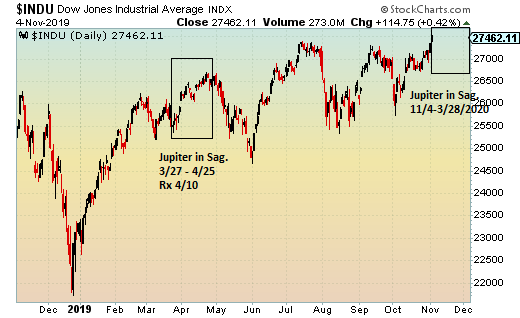
Part of the reason for the strong start to the week on Monday was because Jupiter entered sidereal Sagittarius.  Jupiter is a bullish planet and it is said to do well in Sagittarius, which is the sign it rules and for which it has a close symbolic affinity.  Jupiter transits through the sign of Sagittarius once every 12 years.  This year was something of an exception due to its retrograde cycle which saw it enter Sagittarius on March 27 and then turn retrograde on April 10.  It subsequently left Sagittarius on April 25 and entered Scorpio where it stayed until Sunday November 3.  Jupiter will complete its transit through Sagittarius on March 28, 2020. 


A couple of important points here.  While Jupiter in Sagittarius is generally bullish, I have found it is only really bullish near the entry and exit from Sagittarius.  Therefore, I would not expect stocks to simply rise through the entirety of the transit until March 2020.  Its previous full transit of Sagittarius took place in 2007-2008 which corresponded closely with the financial meltdown.  So that's definitely not bullish! But the entry (Nov 21, 2007) and exit (Dec 9, 2008) from the sign of Sagittarius did highlight a 5 to 10-day period that was more positive. 

I suspect the March-April 2019 period consisted of a longer-lasting 30-day rally possibly because Jupiter stayed in close proximity to that very bullish first degree of Sagittarius.  Also its stationed retrograde on April 10 and Jupiter stations are usually bullish no matter what sign they occur in. 

The bottom line here is that the bullish effects of this entry of Jupiter into Sagittarius may not last very long.  It may not even last through this week.  But Jupiter is likely to play a significant role in boosting sentiment once again as we get closer to December. 

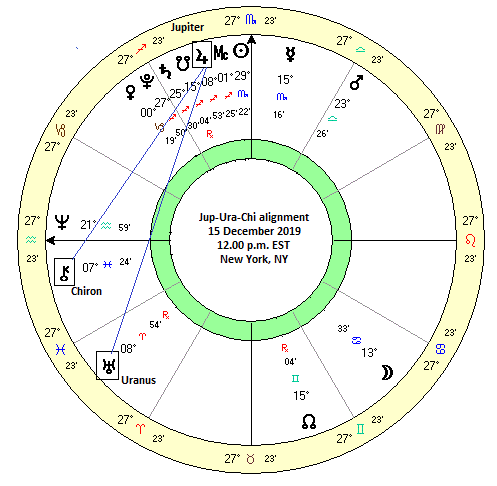
In early and mid-December, Jupiter will align with Uranus and Chiron.  This is likely to create a floor for the stock market and it could well take stocks even higher.  In the event we have seen a pullback in November, the Jupiter-Uranus-Chiron alignment in December could prevent or at least postpone a larger decline, probably until after the holiday season.


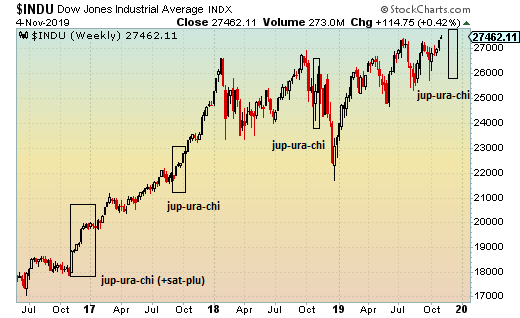
Due to the relatively close ongoing alignment of Uranus and Chiron in recent years, Jupiter has aligned with these two slow-moving planets in late October/early November 2018 and in September 2017.  Both alignments coincided with 3-5% gains during the period in which the three planets were in closest orb.   The Oct/Nov 2018 alignment took place right after the big sell-off in early October and coincided with the bottom and the subsequent late October bounce that topped out around November 8.  While stocks would eventual fall further in the US, late October was a key bottom for Indian stocks.   The Jupiter-Uranus-Chiron alignment therefore provided the bullish fuel for the rebound and recovery that extended into June 2019.  And we should also note that the same alignment was within range at the start of the Trump rally in November 2016, although the exact timing and duration of the alignment was modified and extended somewhat by the presence of Pluto and Saturn.

For a more detailed analysis of the markets, please check out my weekly subscriber newsletter which is published every Saturday afternoon (EST).   I outline the key technical and planetary influences for US and Indian stocks for the short and medium term, as well as currencies, gold and oil.